
 New Delhi


Build Topical Authority for Better Search Visibility
Ranking for a keyword is no longer enough to build organic visibility. Search engines need to understand a website’s content, scope of coverage, and ability to deliver relevant information. That is why businesses should build topical authority instead of publishing standalone articles targeting random keywords.
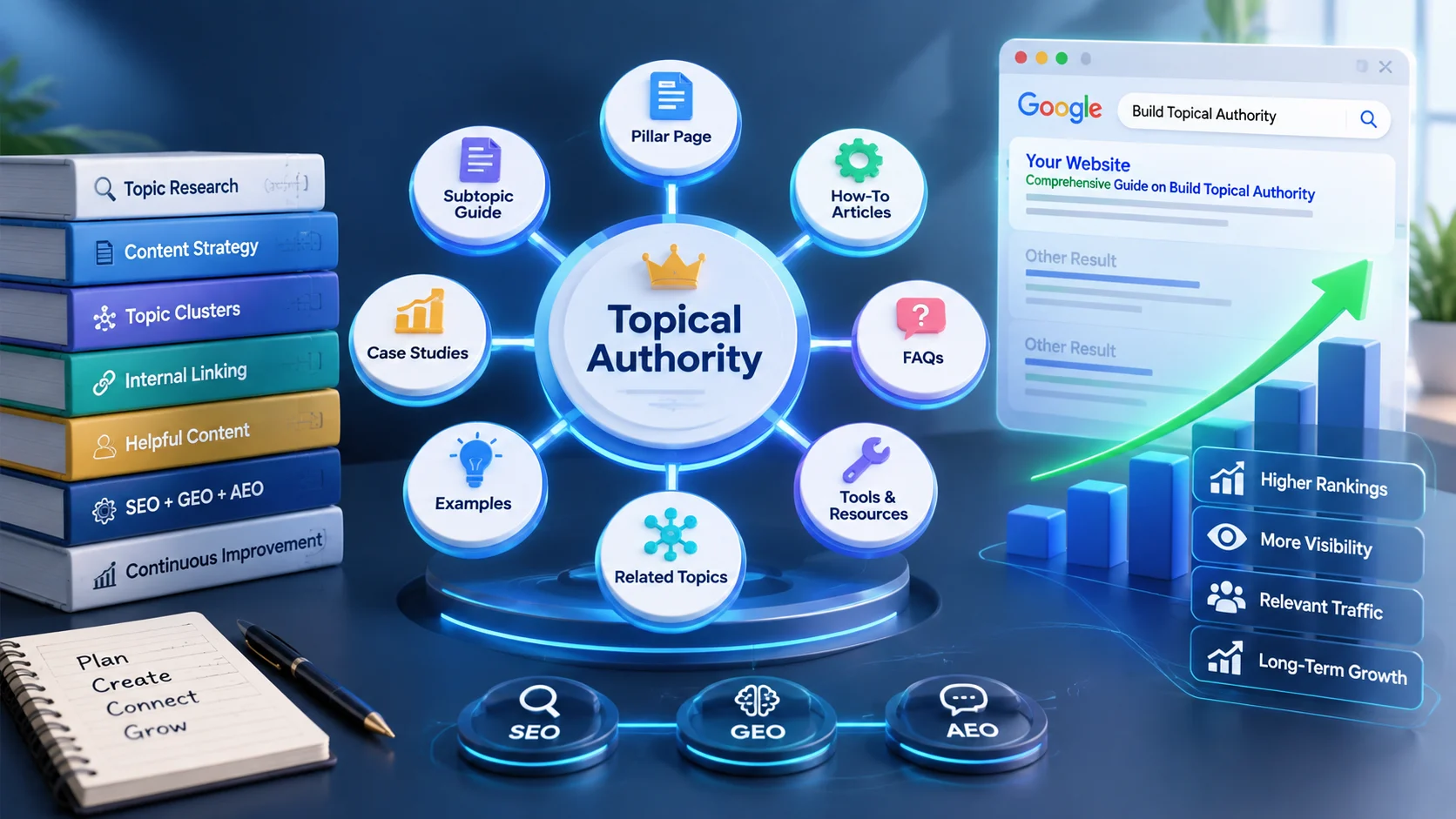
Topical authority refers to showing search engines that a website has comprehensive knowledge and expertise in a certain subject by publishing relevant, useful, and interconnected content. That way, searchers can easily explore the website to find answers to their questions.
What Is Topical Authority?
Topical authority is perceived depth and relevance to a specific subject.
A website dedicated to SEO, for instance, may cover a wide range of topics from keyword research to technical SEO, local SEO, content optimization, internal linking, search intent, link building, AEO, GEO, and AI-powered search, among others. Instead of publishing one standalone article on each topic, the website can be organized to create a topical content ecosystem.
The aim is not to publish hundreds of articles but to have complete, relevant, accurate, and interconnected information that answers multiple questions.
Why Topical Authority Matters for SEO
The search engines’ algorithms are now sophisticated enough to recognize a page’s relevance based on keywords, related topics, content quality, overall structure of the website, and ability to directly answer the searchers’ questions. By building topical authority, a business’s website can target informational, commercial, and problem-seeking searches related to a specific subject.
An SEO-focused website, for instance, may have a pillar page about SEO services and complementary articles covering technical SEO, local SEO, keyword research, search intent, content strategy, internal linking, SEO audits, Google Business Profile, GEO, AEO, and AI-powered search. This way, the website builds topical authority around SEO.
Start With a Core Topic
Identify a core topic that is directly relevant to the business and target audience.
If the business offers digital marketing services, the topics may include SEO, Google Ads, social media marketing, content marketing, or local SEO, among others. Once a topic has been identified, the next step is to brainstorm the questions that the target audience may ask and the problems that they seek to solve.
Rather than concentrating solely on the most competitive questions, it may be beneficial to consider the entire customer journey and address all pertinent questions at various stages. A prospective client, for instance, may search for “What is SEO?” and later narrow down to “technical SEO services,” “SEO audit,” or “SEO agency pricing.” The content strategy should be informative at every level and guide the customer to the next relevant question.
Create Topic Clusters
A topic cluster is a grouping of related topics under a pillar topic.
Using the SEO example, the topic clusters may include:
Pillar Topic: SEO
What is technical SEO?
How does keyword research work?
What is local SEO?
What is search intent?
How does internal linking help SEO?
SEO content strategy
How to measure SEO performance
Each topic cluster can be published as a pillar article to provide in-depth information. The cluster topics should also be related to each other and relevant to the pillar topic.
The website’s visitors will benefit from an informative pillar page and navigational breadcrumbs that lead to related topics.
Focus on Search Intent
The search intent should be the basis of every article.
Before writing a blog, for instance, the writer should know the purpose and the information that the searcher is looking for. Informational searches, for example, may require a definition, description, or instruction. Commercial searches, on the other hand, may need a recommendation, review, comparison, or buying guide. Transactional searches usually require more specific information relevant to the intent to buy.
If the search intent Meeting the search intent is crucial for outranking other sources, even with superior optimization. , it will be difficult to outrank other sources, even with better optimization. To build topical authority, focus on providing in-depth, complete, relevant, easy-to-understand, and well-structured information instead of trying to rank by chasing keywords. Write content that answers questions and not the other way around.
Use Internal Linking Strategically
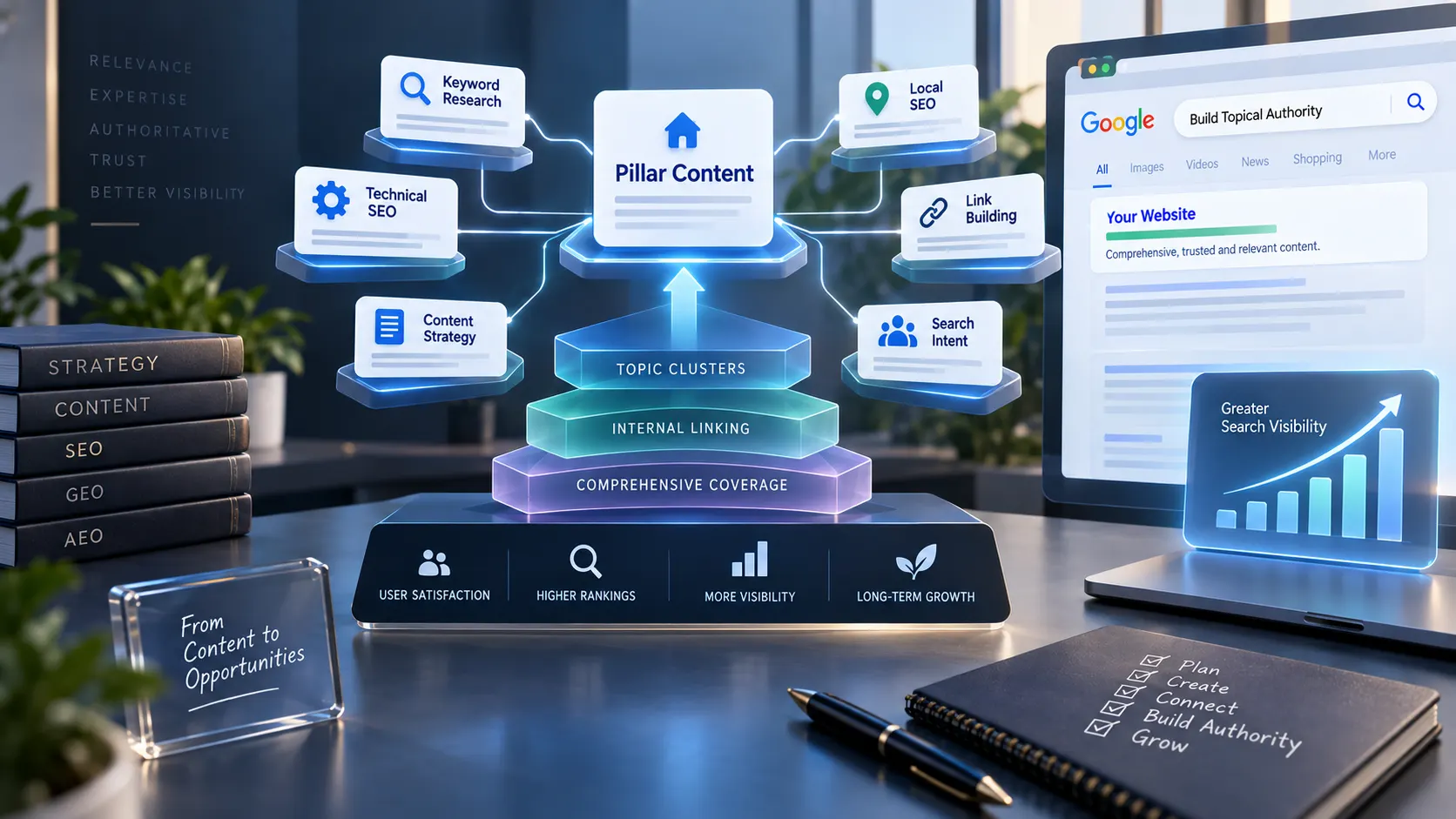
Internal linking is an essential element of a topical content cluster.
Whenever possible, use internal links to connect related topics, especially when one article covers only a segment of a larger topic. It will help the website’s visitors to explore related topics and provide search engines with helpful cues to index the content. If the search engines can easily identify relevant topics and their interconnections, the website will gain topical authority.
An article on keyword research, for example, can benefit from internal links to a more comprehensive guide on search intent. Similarly, a technical SEO guide can be linked to a pillar topic “SEO.” Avoid using internal links for the sake of linking; instead, focus on providing value to the website visitors.
Build Topical Authority With Helpful Content
Quantity is not as important as quality.
Publishing ten useful pages, for instance, can be more valuable than publishing fifty thin pages on similar subjects. Useful content should be:
Original
Accurate
Easy to read and follow
Properly formatted
Relevant to a specific topic or subject
Well-researched and properly cited
Up-to-date
Providing real-life examples, recommendations, and insights can make the article more useful than generic or templated articles on the same topic.
How GEO and AEO Fit Into Topical Authority
Search is increasingly driven by AI-generated answers and conversations. That is why businesses need to optimize content for Answer Engine Optimization (AEO) and Generative Engine Optimization (GEO). AEO focuses on structured content to help search engines to easily identify and use the most relevant information to answer specific questions. On the other hand, GEO is about training the AI to recognize the content’s intent, value, and relevance.
AEO and GEO are becoming more important as search engines become more intelligent and capable of answering questions in natural language. A topical content strategy fits into this framework by organizing the information in a well-structured manner that directly addresses the searchers’ questions. Having informative pillar pages with relevant subtopics, for instance, can help with both AEO and GEO.
Avoid low-quality content targeting specific keywords or topics related to GEO and AEO. Instead, focus on building comprehensive information around a specific subject using properly formatted headers, definitions, relevant examples, and interconnected topics.
Measure and Improve Your Content
Building topical authority is an iterative process.
Monitor the performance of the released content using metrics such as impressions, clicks, traffic, search relevance, conversion rate, and internal linking. Identify the topics and subtopics available on the site and identify how you can expand the information regarding them. Identify the gaps present in the site in terms of information and cover them up.
Perform regular audits of the existing content to make sure that it is still relevant, accurate, and optimized. For instance, there could be some older articles that might not contain critical definitions and optimizations. They must be optimized with more content and information.
Common Topical Authority Mistakes
Some common mistakes when building topical authority include:
Pursuing high-volume keywords simply because they have a lot of traffic.
Publishing multiple similar pages for the same intent.
Trying too hard to optimize without providing value.
Creating duplicate content.
Generating thin content with little or no useful information.
Using irrelevant keywords, topics, and sources.
Generating too many pages of AI content with little or no optimization.
Every page should have a purpose. Avoid publishing random articles about topics that are not relevant to the target audience.
Final Thoughts
Companies can build topical authority simply by focusing on being helpful to the audience rather than the keywords. Companies have to decide on what topic to pick, know the needs of the audience, use the topic clustering technique to create informative pages for various intents, optimize the page, and even improve existing pages. SEO, GEO, and AEO all become very important in today’s searches, and when they are used together, companies can give out the best possible information to the searchers.
Regardless of how advanced the search engine is, being helpful should be the primary aim. Otherwise, no search visibility will be possible.


Comments (0)
No comments yet. Be the first to comment!