
 New Delhi


How Internal Links Can Be Used to Boost Important Pages in Google
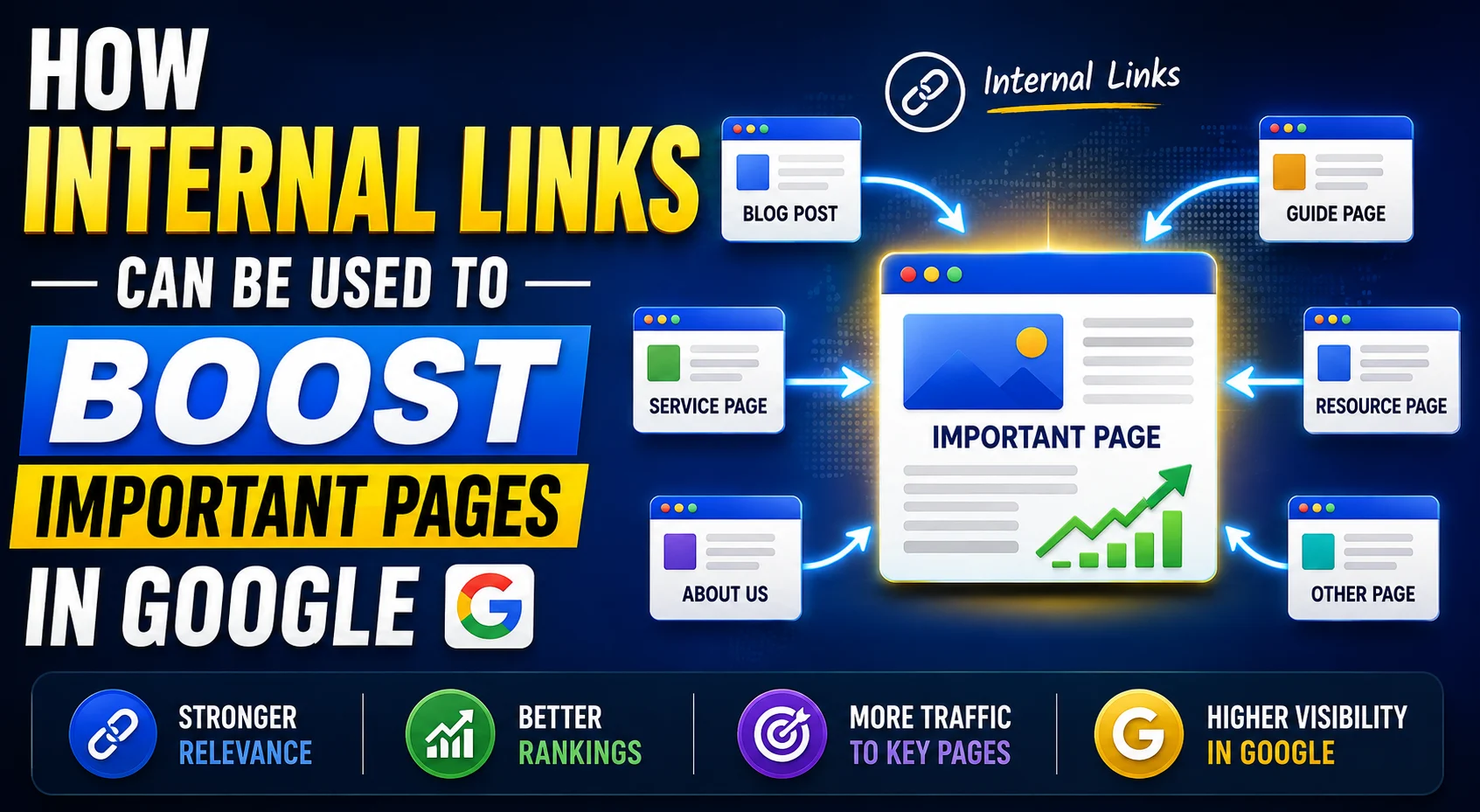
Internal links are one of the easiest SEO techniques that can be leveraged to boost important pages in Google. Internal links help Google discover content and inform the search engine about which assets on the domain are related. Apart from improving overall website structure and UX, internal links can also help Google better understand which pages to prioritize and what content relates to what.
Intro to Internal Links and Their Relevance to SEO
Internal links are hyperlinks that point from one webpage on a domain to another page on the same domain. For example, one might see an article on the blog of an organization that links to the company’s service page. Internal links are different from backlinks, which are links pointing to a domain from another domain. To give an example of an internal linking structure:
Homepage → Service Page → Supporting Blog → Related Blog → Conversion Page
By organizing the website in this manner, one can start to see how one can begin to leverage internal linking to begin to boost one’s important pages up in Google. This kind of structure would also help one avoid having dead ends or unimportant pages with little to no incoming links.
Why Are Internal Links Important to Google?
Google relies on links to discover and understand content. Internal links can help Google discover important content, especially on larger domains with thousands of webpages. Furthermore, internal links can also help Google understand what content relates to what.
For example, if one has a blog article, one can use internal links to point to related web pages, helping Google understand what content relates to it. Instead of using generic anchor texts such as “click here," one can use more descriptive anchor texts pointing to related resources. For example, one could use the anchor text “SEO services in Delhi."
Using the same anchor text repeatedly can make internal links look spammy to Google, so they shouldn't be. While one should strive to use relevant anchor texts for one’s internal links, it is important that one use keyword variations where possible.
How Can Internal Links Help Boost Important Pages?
Help Google Discover Important Pages
A web page with no internal links pointing to it could, theoretically, be undiscovered by Google.
For example, one could have a service page that has all the relevant information on it. If one does not point any internal links to the service page, then one’s service page has no discovery potential. After all, how will Google find it if it is not linked to by anything on one’s domain? Thus, by leveraging internal links to point to one’s important asset pages, one can begin to improve the chances that Google will find one’s important pages.
Distribute Link Equity Across One’s Pages
Not every page has equal potential to earn backlinks from high-authority domains, nor do all web pages have equal potential to organically gain traffic. Thus, one must utilize one’s existing link equity to one's advantage. For example, one’s blog article might be one of one’s pages with the highest number of referring domains. One can use this to one’s advantage by linking to other relevant pages from this blog article, passing along its link equity to other relevant pages.
One must ensure that one’s internal links are relevant, both in terms of the page linking out as well as the page linking in.
Establish a Strong Content Hierarchy and Help Google Understand What Content Relates to What
One of the best ways to help Google understand one’s content better is to build a strong internal linking structure that defines one’s content hierarchy. For example, let us imagine that one has a digital marketing website and has the following pages:
Now, one can use one’s internal links to help Google understand that one’s website is about digital marketing and that one’s website contains content pertaining to SEO. One could also use internal links to help Google understand the relationship between one’s content. For example, one could begin to make connections between keyword research and SEO services.
Identify Important Pages on One’s Site
Internal links can be used to identify important pages on one’s site, as well. By pointing several internal links to a page, one can demonstrate to Google that the page is important.
For example, one’s most important page could be one’s SEO services page. Thus, one can begin to build internal links to this page from other pages on one’s domain that are relevant to the content on one’s SEO services page. Thus, if one’s SEO services page is one’s most commercially viable page, one can begin to build internal links to it from one’s blog articles on SEO. For example, if one has blog articles on keyword research, technical SEO, local SEO, and SEO services in general, one can begin to build internal links pointing to one’s SEO services page.
This demonstrates to Google that relevant content points to one’s commercial page, which should, subsequently, improve its visibility in Google. Thus, one’s SEO services page will appear as a relevant result to anyone searching for anything related to SEO. This helps one’s SEO efforts immensely, as one’s most important page will be what appears in Google when one’s target audience is searching for one’s offerings.
Improve UX and Encourage Users to Visit More Pages on One’s Website
One of the main advantages of internal linking is that it also improves the overall UX of one’s website. For example, if one reads an article on technical SEO, one might want to know more about technical SEO services and how it can benefit one’s business. By having a relevant internal link pointing to one’s technical SEO services page, one does not have to go back to Google to search for technical SEO services. This helps improve one’s UX, which, subsequently, also helps one’s SEO efforts. After all, Google prioritizes websites with faster loading speeds and better UX.
How to Build an Effective Structure
Start with One’s Most Important Pages
The first thing one should do when building one’s internal linking structure is to identify one’s most important pages. For example, one’s most important pages could be one’s service, product, category, location, landing, and resource pages. From here, one should begin building backlinks to one’s most important asset pages using one’s other relevant pages. For example, one’s blog articles can be used to build backlinks to one’s service, product, and resource pages.
Find Other Relevant Content Pages
Once one has identified one’s most important pages, the next step is to look for other relevant content pages. For example, if one has a blog article about local SEO, one can begin building internal links pointing to one’s local SEO service page. However, it is important that one does not use irrelevant blog articles to build internal links, as this will not benefit both the user and Google. Thus, one should build internal links only from relevant blog articles and resource pages.
Create Descriptive Anchor Text
When building internal links, it is important that one uses descriptive anchor text. Essentially, the anchor text should briefly describe what the linked page is about. For example, instead of using the anchor text “Technical SEO Services," one could use the anchor text “Learn more about Technical SEO Services." It is also important that one does not use the same anchor text for all one’s internal links. After all, one does not want one’s internal links to look spammy. It is always a good idea to vary one’s anchor text while still keeping it descriptive.
Link From Relevant High-Traffic Pages
High-traffic pages can be excellent places to build internal links, as they already get a significant amount of traffic. Furthermore, some pages might also have greater numbers of referring domains, meaning that they are already trusted by Google.
When building one’s internal links, one should look at one’s website and identify one’s high-traffic pages and high-authority pages. Once these have been identified, one can begin building internal links from these pages to one’s other relevant pages. Thus, one can also build internal links from one’s high-authority pages, helping to boost one’s other relevant pages.
Avoid Common Internal Linking Mistakes
When one begins to build one’s internal linking structure, it is important to avoid these common linking mistakes:
• Internal linking should not be overdone.
• Internal links should have relevant anchor text.
• One should not link to the same page over and over.
• One should avoid creating orphan pages.
• One should avoid using broken links.
• One should avoid building overly complex website architecture.
• One should avoid using internal links to manipulate keywords, etc.
The key to building one’s internal linking structure is to focus on quality over quantity.
Internal Links and Topic Clusters
When it comes to building one’s internal linking structure, it is also important to build topic clusters. This entails building a pillar page, as well as several other cluster pages relevant to the pillar page. For example, one might build an SEO services pillar page, as well as several other pages relevant to SEO services, such as technical SEO services, local SEO services, and on-page SEO services. These cluster pages can, subsequently, be linked to one’s pillar page, helping to improve one’s SEO. Additionally, one’s pillar page can also be linked to each of one’s cluster pages, helping to build one’s internal linking structure. This can be an extremely useful addition to one’s SEO efforts, as it demonstrates to Google that one’s pages are related.
How to Monitor One’s Internal Linking Progress
By making use of one’s internal links, one can begin to see improvements to one’s traffic, engagement, and conversions. Some metrics one should monitor when making use of one’s internal linking structure include one’s:
organic impressions,
organic clicks,
keyword rankings,
traffic,
crawlability,
indexed pages,
engagement,
conversions,
etc.
If one uses Google Search Console, one can monitor impressions and clicks, as well as one’s average position. If one’s page has high impressions but few clicks, then it is likely that one’s page is not performing as well as it should, and one should optimize one’s on-page SEO or internal linking. Ultimately, it is important that one monitors one’s internal linking progress in order to constantly optimize one’s linking structure.
Conclusion
Internal links are an incredibly important component of SEO, as they can help Google discover one’s content and better understand one’s content structure. Internal links can also help boost one’s important pages while also improving one’s UX. One can build one’s internal linking structure around one’s most important asset pages, using one’s other relevant content pages to build links to one’s important pages. It is important that one’s anchor texts are descriptive and relevant. One should focus on building one’s content hierarchy around one’s pillar pages, linking one’s cluster pages to one’s pillar pages, and linking one’s pillar pages to one’s cluster pages. Internal linking can be a great addition to one’s SEO efforts when optimized correctly. As such, when combined with one’s great content creation efforts, one’s improved technical SEO, website UX, and one’s backlink profile, one’s internal linking efforts can serve as an incredible catalyst for one’s SEO efforts.


Comments (0)
No comments yet. Be the first to comment!