
 New Delhi


Why Your Google Search Console Clicks Are Suddenly Droppinggoogle-search-console-clicks-dropping
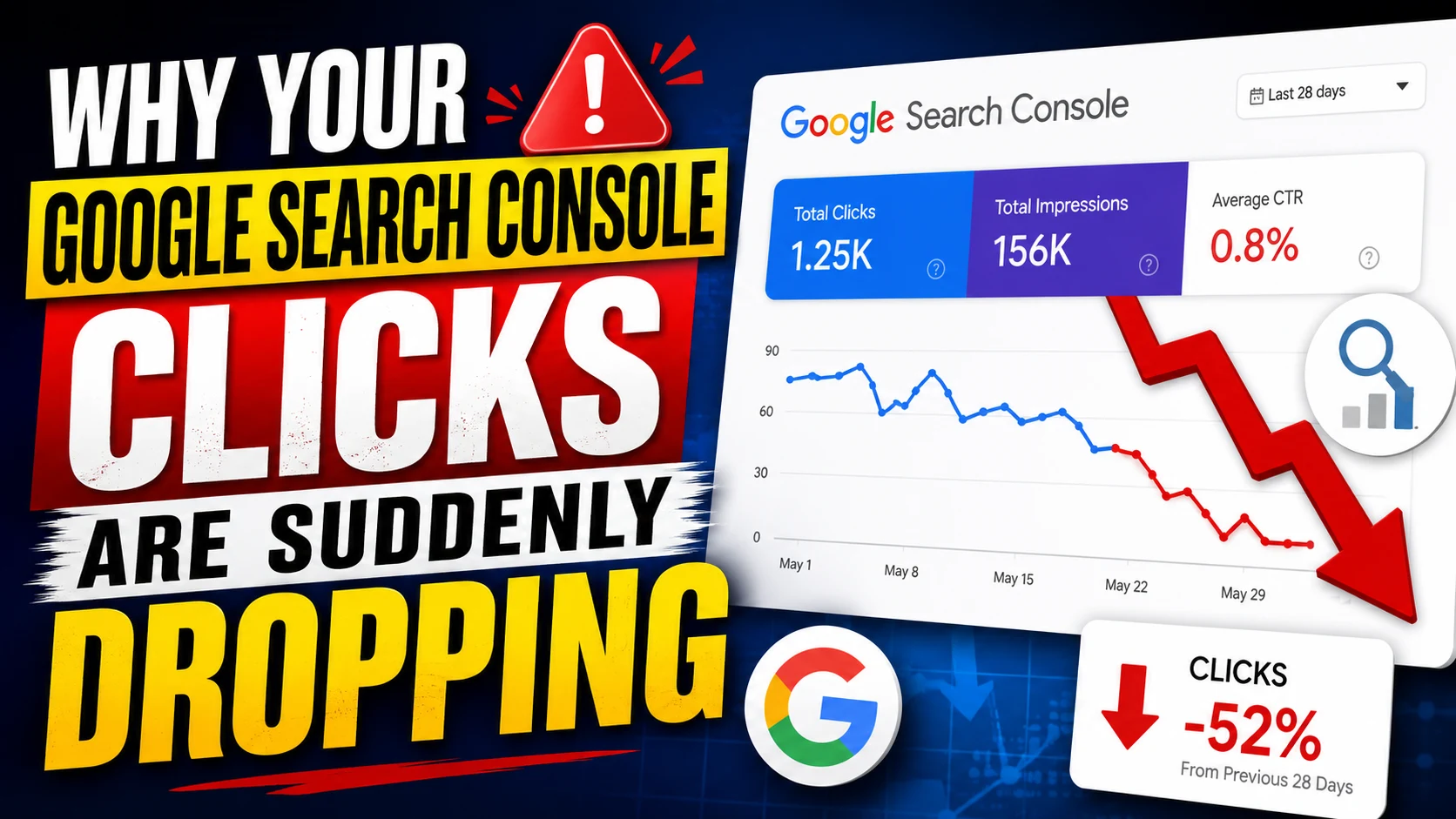
Finding that your clicks in Google Search Console suddenly dropped is always a stressful moment. Your website has stopped being discovered by searchers – but why? A drop in Google Search Console clicks doesn't necessarily mean disaster for your SEO campaign, however. There are many possible explanations for disappearing impressions, plunging click-through rates (CTR), seasonal drops, indexing problems, changes in search features, and more. Google recommends investigating the issue by analysing the performance report by queries, pages, countries, devices, and search appearance before making any major alterations to your SEO strategy.
What Do Clicks Actually Represent in Google Search Console?
A click in Google Search Console is a click made by users on your listing or link on Google Search or any Google site. An impression refers to the number of times that your link was shown in the Google search results, whereas CTR is the ratio between clicks and impressions. It’s crucial to look at both numbers together, as a reduction in one of them may mean something different than in the other one.
For instance, a loss of impressions with roughly the same number of clicks would indicate a drop in CTR, while a drop in both impressions and clicks would suggest a loss of visibility. These are just two examples – analysing the figures will help sort out the cause of the issue.
1. Make Sure Impressions Haven't Also Fallen
The first step in troubleshooting a sudden drop in clicks is ensuring that impressions haven't also fallen. In the performance report, compare the numbers for the last period versus the period before it. If impressions have decreased, there may be several possible causes, including:
• Ranking losses
• Lost indexed pages
• Reduced search volume
• Competitive gains
• Core algorithm updates
• Crawling and technical issues
• Seasonality
Google Search recommends investigating traffic issues by looking at queries, pages, countries, devices, and search appearance.
Now, if impressions are steady but clicks have fallen, it's time to look at the CTR.
2. Your Rankings Could Have Changed
Your page rankings could have changed, causing your CTR and impressions to drop along with your clicks. If a page previously appeared in position 2 but now only appears in position 5, this would cause a substantial loss of traffic. The same goes for a larger leap between the previous and current positions – or even an entire loss of visibility if a highly ranked page suddenly slips out of the top results.
Google Search Console's performance report contains data on the largest position drops for queries and pages, which can help isolate the exact cause. The same applies to an analysis of the current positions versus the positions from the previous period.
Google notes that rankings in organic search can fluctuate due to several factors, including changes made by competitors, searcher intent, and the constant evolution of Google's algorithms.
3. Your CTR Might Have Fallen, Too
If searchers are still clicking on roughly the same number of pages – but just not yours – it may be because your CTR has dropped. Look for keywords and queries with:
• Similar impressions
• Lower clicks
• Lower CTR
• Steady or nearly steady average position
Google recommends looking at pages with impressions but fewer clicks than average when troubleshooting a drop in CTR. Titles should be examined for relevance and appeal versus the competition, since it's likely that other pages are presenting more enticing value propositions to searchers. Clickbait should be avoided, as it typically leads to wasted impressions for SEO purposes.
4. Look for Indexing and Technical Issues
Sometimes, there may be a technical issue that may result in a huge traffic decline. When the pages indexed get excluded from the index or become inaccessible to Google, there may be a sudden drop in the number of impressions. At such times, the Page Indexing report may help you determine the URLs with problems and understand why these URLs got excluded or de-listed. The reasons why this happens could be noindex, canonicalisation, robots.txt, redirect loop, server error, de-listing, or lack of internal linking.
As per Google, the pages may disappear from search due to improper indexing or when a different canonical page gets selected than the one desired by the webmaster.
5. Could a Google Core Update Be Responsible?
A sharp drop in impressions and traffic may have occurred due to a Google core update. Core updates are large-scale algorithm changes that affect how Google understands search intent and delivers results. They do not punish sites, however – the changes are typically meant to improve the quality and relevance of search results.
If your traffic appears to have dropped in conjunction with a known core update, Google recommends not making sweeping changes to your SEO strategy across the board. Instead, it asks that you analyse the performance of your queries, web pages, and topics to identify what might have changed and why. The recommendations also ask that you review changes to the site following the date of the core update.
6. Search Volume and Demand Can Fluctuate
Not all traffic drops are the result of specific issues affecting your website, content, or SEO. Demand for many subjects varies from year to year, month to month, and even week to week. This is true for seasonal searches, as well as searches for products, services, and topics affected by ongoing events. When possible, compare your figures to the same time period in the previous year to rule out natural fluctuations in demand. Google also recommends using Google Trends and Search Console in tandem when analysing a drop in organic traffic.
This is especially important for websites that feature seasonal content, products, and services.
7. Don't Forget About Search Features and AI Results
The traditional blue links are no longer the only way users can access websites via Google Search. Featured snippets, carousels, images, video carousels, and AI overviews all impact how traffic flows to web pages. Google Search's documentation states that AI Overviews are reported and tracked inside Search Console, per the company's reporting policies. For AEO and GEO optimisation, Google recommends creating content with direct answers to important questions using clear headings, reliable information, and expert voices. Answers must be structured in a way that makes it easy for search engines and AI to process them without the use of keyword stuffing.
8. Narrow Down the Issue to Pages, Queries, Countries, and Devices
Analysing clicks at the global or aggregated level can hide valuable insights about specific issues affecting certain queries, pages, countries, and devices. As an example, the drop in clicks may only apply to mobile devices but not desktop computers. Or the issue may be isolated to one country, one specific page, non-branded searches, or Google Images. The performance report can be used to filter results by pages, countries, devices, and search appearance to help sort out which areas are having issues and why. This is especially crucial for local SEO, as a drop in visibility for one city could be completely separate from the issue affecting the rest of the country.
A Few Quick Checks Before You Panic
When faced with a sudden drop in Google Search Console clicks, it's important to analyse the situation before taking any drastic action. Google recommends the following steps:
Compare the clicks and impressions figures from the last period to the impressions of the period before it.
Examine the pages with the largest losses in traffic.
Look for queries with drops in either rankings or CTR.
Review the indexing status of any affected web pages.
Investigate any technical changes that might have occurred close to the traffic drop.
Compare figures for desktop and mobile searches
Check for Google updates or anomalies reported by Google
Review the performance of your competitors and the shifting intent of searchers
Consider revising any outdated or ineffective content.
Measure the impact of any alterations you make to your SEO strategy.
Google has a dedicated page for reported data anomalies, as issues with the Search Console can sometimes affect figures.
Conclusion
When clicks in Google Search Console plummet out of the blue, it can cause immediate concern. The truth is, there are multiple possible causes for a drop in clicks, from fewer impressions to drops in CTR, indexing issues, seasonal declines in demand, competitive gains, and more. By investigating the issue at the page level and using both traditional SEO and AEO/GEO tactics, it's possible to troubleshoot the issue and even turn it around. After all, optimisation is inherently about adapting to ever-changing circumstances in the pursuit of higher visibility and better content.


Comments (0)
No comments yet. Be the first to comment!