
 New Delhi


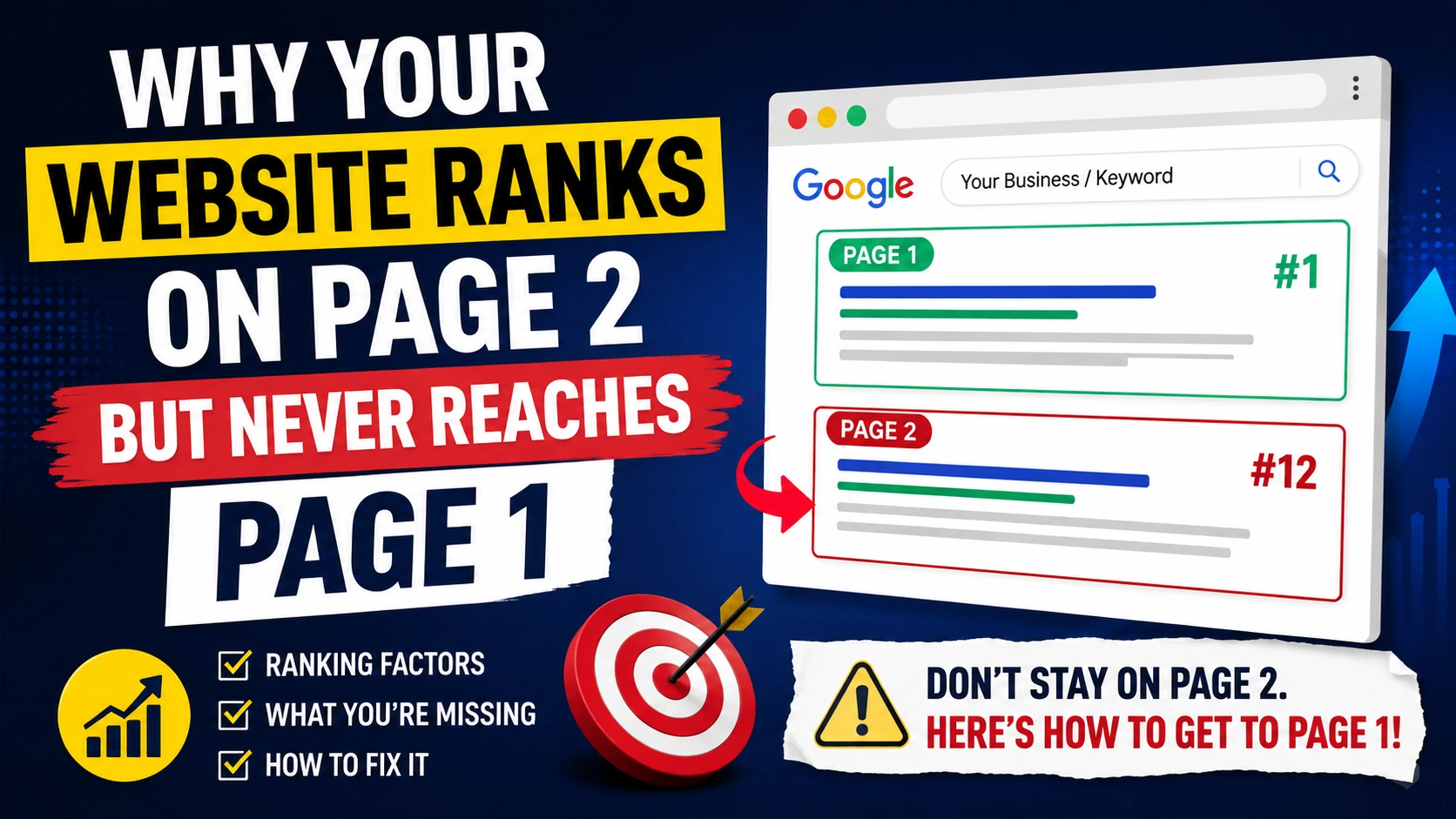
Why Your Website Ranks on Page 2 but Never Reaches Page 1
If your website ranks second on the Google search results page, this means that while Google recognizes that your page is relevant, it still considers the other competing websites to be more relevant for the same reason: their higher relevance in terms of the following factors: search intent, content quality, authority, internal links, and usability. In any case, ranking second on Google search results is an excellent SEO opportunity for you because your page has become quite visible. The best way to achieve it is to understand the difference between your page and top-ranked pages.
1. Your Website Ranks, But the Content May Miss Search Intent
Search intent is one of the factors that play a crucial role in achieving organic rankings. Google aims to bring back the most relevant results for what users are actually searching for.
For instance, when a person types in “SEO agency in Delhi,” that person could be searching for a service provider, comparing agencies, checking services, or looking at prices. An informative article on SEO may fail to meet the user's commercial needs for such a search.
Look at the websites' rankings on page 1 and see what type of content they have there. Are those service pages, thorough guidelines, comparison articles, case studies, or location-based content?
If your format does not align with the search intent, optimising the website to match the user’s objectives will prove more useful than just adding a bunch of keywords.
2. Your Content Needs More Original Value
One common reason for a website landing on the second page of search results is the comparison of its published material with that of competitors.
Publishing an unoriginal article with information already found in hundreds of sources isn't likely to deliver significant results when working on organic ranking. Nonetheless, one needs to make their content beneficial by finding original ideas and using useful examples.
Consider adding:
Real-world examples
Case studies
Expert opinions
Original research
Screenshots
Step-by-step processes
Industry-specific recommendations
Frequently asked questions
Updated statistics
For example, rather than simply explaining SEO ranking factors, explain how a business can identify ranking problems and prioritize the right improvements.
This creates a better experience for readers and gives search engines more reasons to consider your page valuable.
3. Build Topical Authority Around Your Main Keyword
A single page may not be enough to establish authority for a competitive topic.
If your website features a service page that is focused on Best SEO Agency in Delhi, then that service could be complemented with useful content related to local SEO, technical SEO, keyword research, SEO audits, link building, Google Business Profile optimization, SEO pricing, and on-page SEO.
Connect these articles using relevant internal links.
For example:
SEO Guide → Technical SEO → SEO Audit → Local SEO → SEO Services
Thus, there is a creation of a topic cluster that is interconnected and leads to the building of a website that can help search engines understand the relationship of pages.
In addition, with multiple related searches getting rankings within the website, there is a strong topical relevance created around the topic.
4. Strengthen Internal Linking
Internal linking is one of the easiest areas to improve when a page is stuck on page 2.
Browse through your current blogging platform and service pages to identify relevant pages where you could link naturally. It should add value rather than just being done to improve search rankings.
You should always choose naturally sounding and descriptive anchor text for the link. A blog that discusses local SEO could use the anchor text SEO services in Delhi when referring to a corresponding service page.
It is better not to use the same anchor text every time. You may use some variations like professional SEO services, SEO solutions, or SEO experts in Delhi only when they correspond to the surrounding context.
A thoughtfully planned internal linking system will allow distributing link juice and make valuable pages easier to reach.
5. Your Competitors May Have Stronger Authority
Content quality is only one part of the ranking equation. Your competitors may have stronger websites, more relevant backlinks, better topical coverage, or greater brand authority.
Compare your page with the results appearing above it. Look at their:
Content depth
Backlink quality
Internal links
Topic coverage
Page experience
Brand credibility
Content freshness
If competitors have significantly stronger authority, adding more words alone is unlikely to solve the problem.
Instead, focus on earning relevant backlinks through original research, digital PR, industry resources, expert contributions, useful guides, and case studies.
The focus should be on relevance and quality, not simply collecting a large number of links.
6. Technical SEO Could Be Holding You Back
Sometimes the content is good, but technical issues prevent better performance.
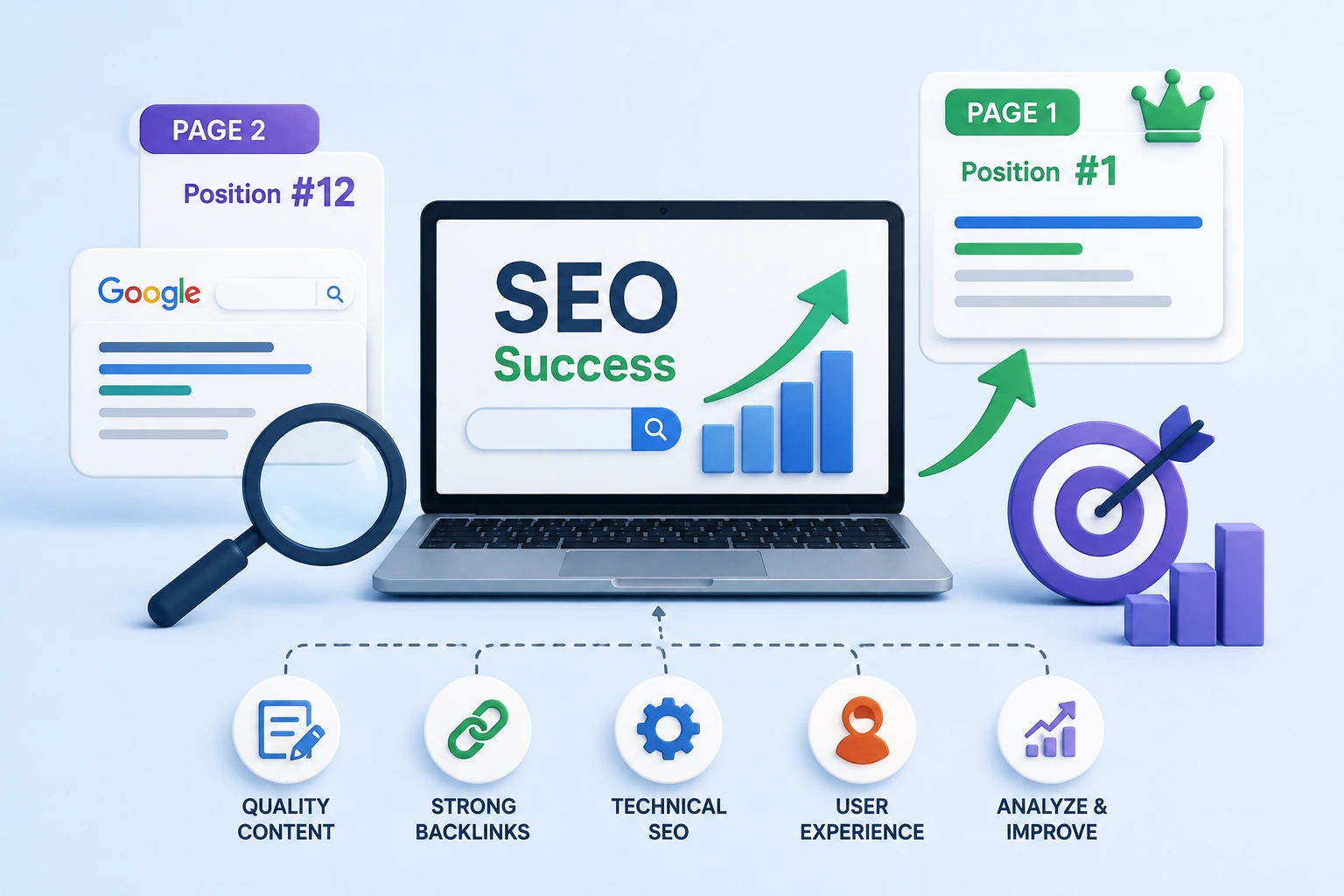
Check important elements such as
Page speed
Mobile usability
Core Web Vitals
Indexing
Canonical tags
Redirects
Broken links
XML sitemap
Structured data
You should also check whether the correct URL is ranking for your target query. If multiple pages cover nearly identical topics, they may compete with each other.
Fixing technical SEO problems can create a stronger foundation for your content and make it easier for search engines to crawl, understand, and index your pages.
7. Make Your Content AEO-Friendly
In today's world, SEO is not the only thing to pay attention to. With the advent of AI-enabled search engines, users receive answers directly.
Therefore, Answer Engine Optimization (AEO) is also important for content creation today.
Provide answers in the key parts of the text first and then elaborate on them later.
Use headings, short paragraphs, lists, FAQs, definitions, and instructions.
In this article, the answer to the main question has been given right away, and only after that have the reasons for the second-page placement been explained.
This structure helps users skim through the information easily as well as assist search engines in comprehending the content.
8. Improve GEO and AI Search Visibility
Generative Engine Optimization, or GEO, signifies the process of simplifying content so that it can be better grasped by AI-driven search platforms.
Your focus should be not on manipulating the AI systems but on developing worthwhile content that is reliable and pertinent.
You must demonstrate your level of expertise by sharing your thoughts and opinions, using the same information about your enterprise without any changes, straightforwardly presenting complex ideas, and backing up the most important statements with trustworthy information.
As a consequence, it is necessary to have an SEO plan that works for both conventional and modern AI search engines.
The spirit of GEO lies not in producing another piece of content for a different system but in creating valuable material for any type of search engine.
9. Improve Your Title and Meta Description
A page can have good rankings but still receive fewer clicks if its title and description fail to communicate value.
Compare:
SEO Ranking Tips for Businesses
with:
Why Your Website Ranks on Page 2 but Never Reaches Page 1
The second headline formulates the real problem and the advantages that the reader will obtain from it.
Do not forget to create your headlines in such a manner that they contain an informative description of the content of the page.
Your meta description should include a statement of what the reader will get from reading this page.
The major task here is to use keywords properly and not to misuse them. The most attractive snippet should be considered for the target audience.
10. Page 2 Is an Opportunity, Not a Failure
If your website ranks between positions 11 and 20, Google has already recognized some relevance. Instead of immediately creating another page, analyze the existing one.
Ask:
What are the page-1 results doing better?
Possibly, they provide additional answers to questions. They could also add examples to clarify their arguments, include links from various sources, give more comprehensive coverage of the subject, or ensure a higher-quality user experience.
The next step is to research these inconsistencies, modify the current page accordingly, and evaluate its efficiency after the changes in the Google Search Console.
A Practical Strategy for Better Rankings
There is a possibility that they would provide answers to additional queries. They might also include some examples to clarify their points, refer to different references, describe the subject in more detail, or improve the quality of user experience.
The next step is to investigate all these discrepancies, change the page as needed, and monitor its effectiveness after the alterations via Google Search Console.
Conclusion
If your website is ranked on the second page of Google, making it to the first page would not simply depend on applying the best keywords. High positions on the second page suggest possible errors that should be fixed because a website might suffer from a lack of content, low search intent correlation, absence of topical authority, ineffective internal linking, low number of external backlinks, technical errors, and user-unfriendliness.
If you have already managed to get on the second page, you should make the most of this success and identify the reasons preventing better organic rankings.
If you want to improve your performance, you should implement SEO techniques and AEO-friendly methods, GEO-targeting, and well-designed internal linking strategies.
If you are part of a highly competitive niche, for instance, Delhi businesses, it may be wise to find a reputable Delhi SEO agency to take the best steps for improving your online visibility.


Comments (0)
No comments yet. Be the first to comment!