
 New Delhi


How Animated Videos Can Boost Your Social Media Marketing Strategy
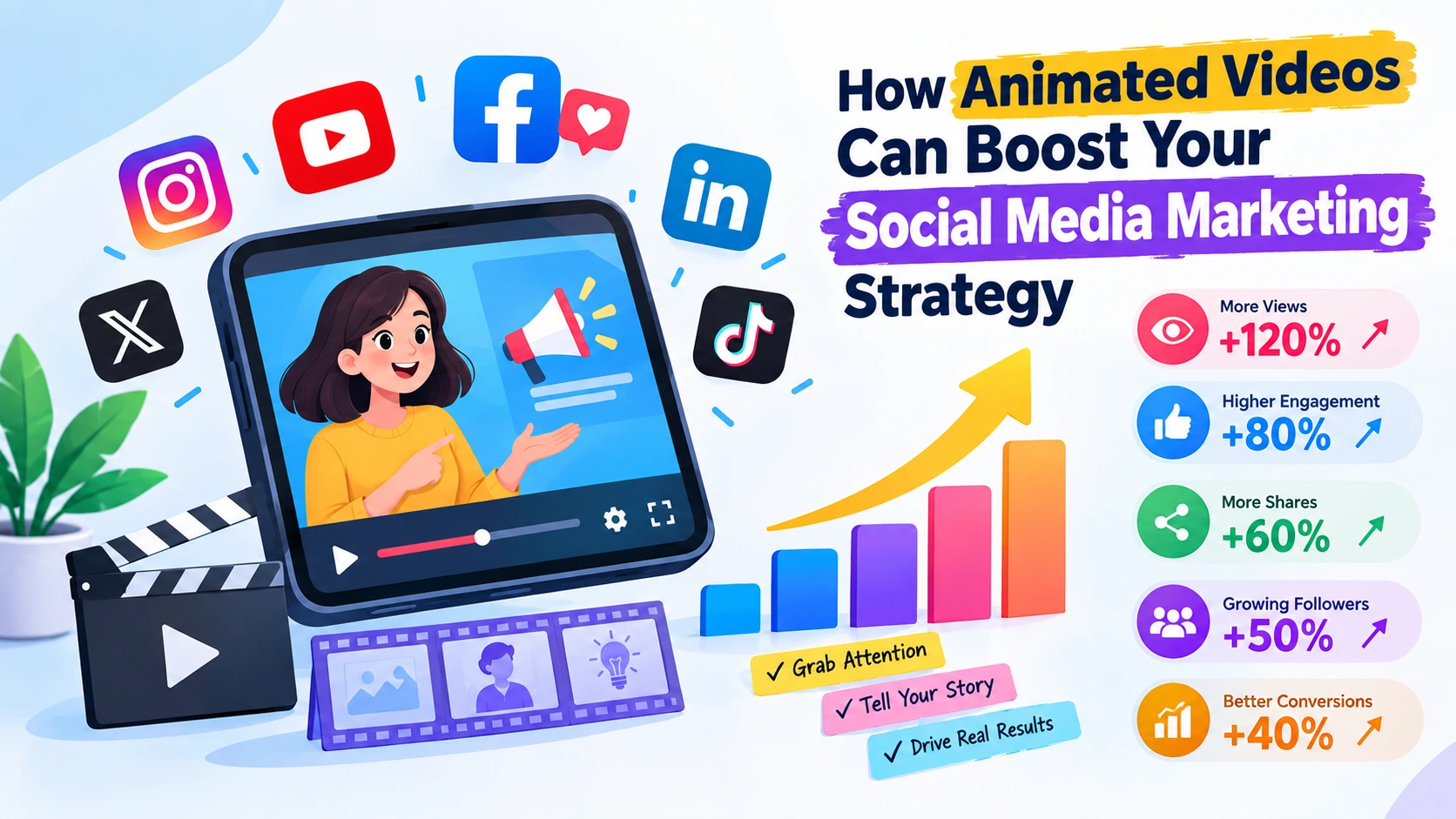
Let’s take a look at the statistics related to this matter and explore how to utilise animation without feeling like a business afterthought.
Video Is No Longer Optional
An estimated 91% of business corporations today are turning to video as a marketing strategy in contrast to just 61% in 2016, indicating that there is a great need for video creation in marketing campaigns of different organizations. Indeed, according to 84% of consumers, they would like to see many more videos from different brands. The ordinary person spends about 17 hours per week watching videos, which constitute about 82% of total online traffic worldwide.
Today, it is not enough to create videos, but they must also be sufficiently interesting and valuable to be watched from the beginning to the end.
Why Animated Videos Work So Well on Social Media
Social platforms reward watch time. Instagram Reels, TikTok, YouTube Shorts, LinkedIn, and Facebook all push videos that hold attention, and animation is built for this.
They stop the scroll. Lively colours, action, and fun characters capture attention in a bustling feed. A video has two to three seconds to hook the audience, and animation can be an influential attraction in those moments.
They simplify complex ideas. If you have a SaaS solution, a financial service, or a complicated technical procedure, animation helps you explain it as a nice short story of about 30 seconds. The reason is that around 63% of consumers consider a short video the best way to learn about a service or a product.
They work without sound. Many people watch on mute, especially on mobile, and about 75% of consumers watch video on mobile devices. Animation with kinetic text and captions communicates perfectly with the volume off.
The Business Impact: What the Data Shows
Animation isn't just pretty. Video, in general, delivers measurable results, and animation is one of its most flexible forms:
93% of video marketers say video has helped increase brand awareness.
85% say it has helped generate leads
83% say it has directly increased sales.
82% report a good return on investment.
85% of people have been convinced to buy a product or service after watching a video.
Websites with video convert at an average of 4.8%, compared with 2.9% for those without.
Short-form content leads the way, too. HubSpot's 2026 data ranks short-form video as the highest ROI content format, cited by 49% of marketers. And for explainers specifically, adding an explainer video can lift landing page conversions by up to 80%.
Boost Engagement and Brand Recall
People remember storytelling and visuals much better than bullet points. Using an engaging mascot, maintaining the same colour palette, and using a well-identified animation style will help in creating a brand that can be recognised. When someone sees the company's next post, he will know that it comes from that company.
The rise in engagement indicates high quality of content according to algorithms. The number of likes, comments, shares, and saves increases the organic reach of content and decreases advertising costs.
Flexible and Budget-Friendly
In contrast to live-action productions, animated content doesn’t require actors, settings, or lighting teams. If there’s a need to amend the content, it can easily be corrected through script editing or scene adjustments rather than re-doing the scene altogether. These are just a few of the reasons that 63% of video marketers say they utilise AI video technology, up from 51% a year earlier. Thus, even small teams can develop and distribute the needed content on a regular basis.
Animation fits every stage of the customer journey:
Explainer videos that introduce your product or service
Short social ads for Reels, Stories, and TikTok
Testimonial animations that bring customer feedback to life (57% of video marketers created testimonial videos)
Educational content like tips, how-tos, and FAQs
Event promotions and seasonal campaigns
One animation can also be repurposed: a 60-second cut for YouTube, a 15-second teaser for Instagram, and a vertical clip for TikTok. Create once, publish everywhere.
How to Make Animated Videos That Feel Human
The biggest mistake brands make is creating animations that feel cold and salesy. People connect with people, even when the characters are drawn.
Start with a real problem. Open with a situation your audience actually faces, like "Tired of spending hours on reports?" Empathy hooks faster than a logo.
Write like you talk. Imagine explaining it to a friend over coffee. Skip the jargon.
Add personality. Humour, expressive characters, and a little imperfection make animation feel alive.
Tell a mini story. Problem, struggle, solution. Stories keep people watching.
Hook viewers in three seconds. Lead with your most interesting visual or question.
End with one clear call to action. Follow, click, download, or book a demo. Just one.
Optimise for SEO, Google, and Local Search.
Great video only works if people can find it.
Use keywords naturally in titles, captions, descriptions, and hashtags. "Animated explainer video for small businesses" beats "Our New Video".
Add captions and transcripts. They improve accessibility and give search engines text to index.
Upload to YouTube. It has 2.7 billion monthly active users, and it's a search engine in its own right. Add a keyword-rich description and a link back to your site.
Embed videos on your blog or website to increase time on page.
Add video schema markup so Google can show rich video results.
Answer real questions. Build videos around queries your audience searches for, like "How does [your service] work?" This supports Google's helpful-content approach and improves your chances of appearing in AI-generated answers.
Go local. Include location terms in captions and descriptions (like "video marketing services in Delhi") and tag your location on Instagram and Facebook.
Common Mistakes to Avoid
Videos that run too long. Keep social animations between 15 and 60 seconds. Wistia's 2026 report found engagement drops as videos get longer.
Ignoring vertical format. Design mobile-first in 9:16.
Skipping captions. You lose everyone watching on mute.
Cramming in too much. One video, one idea.
Posting inconsistently. Regular publishing builds momentum and trust.
Measure What Matters
Track view-through rate, average watch time, shares, click-through rate, and conversions. Test different lengths, styles, and hooks, then double down on what works.
Final Thoughts
Today, video is the standard, so being unique simply requires creativity and transparency. Animation allows you to communicate more quickly, showcase your brand, and attract the attention of consumers in a crowded connection. Start small – choose a product, one issue, and make it into a 30-second story. Publish, learn, improve. Your audience is already turning their thumbs. Give them something to stop for.


Comments (0)
No comments yet. Be the first to comment!