
 New Delhi


How to Find Pages That Are Killing Your Website’s SEO Performance
But certain pages can negatively affect your website’s SEO performance even though your website appears to be in perfect shape. Pages with thin content, duplicate pages, poor internal link structure, out-of-date content, and others can be underperforming in search engine rankings.
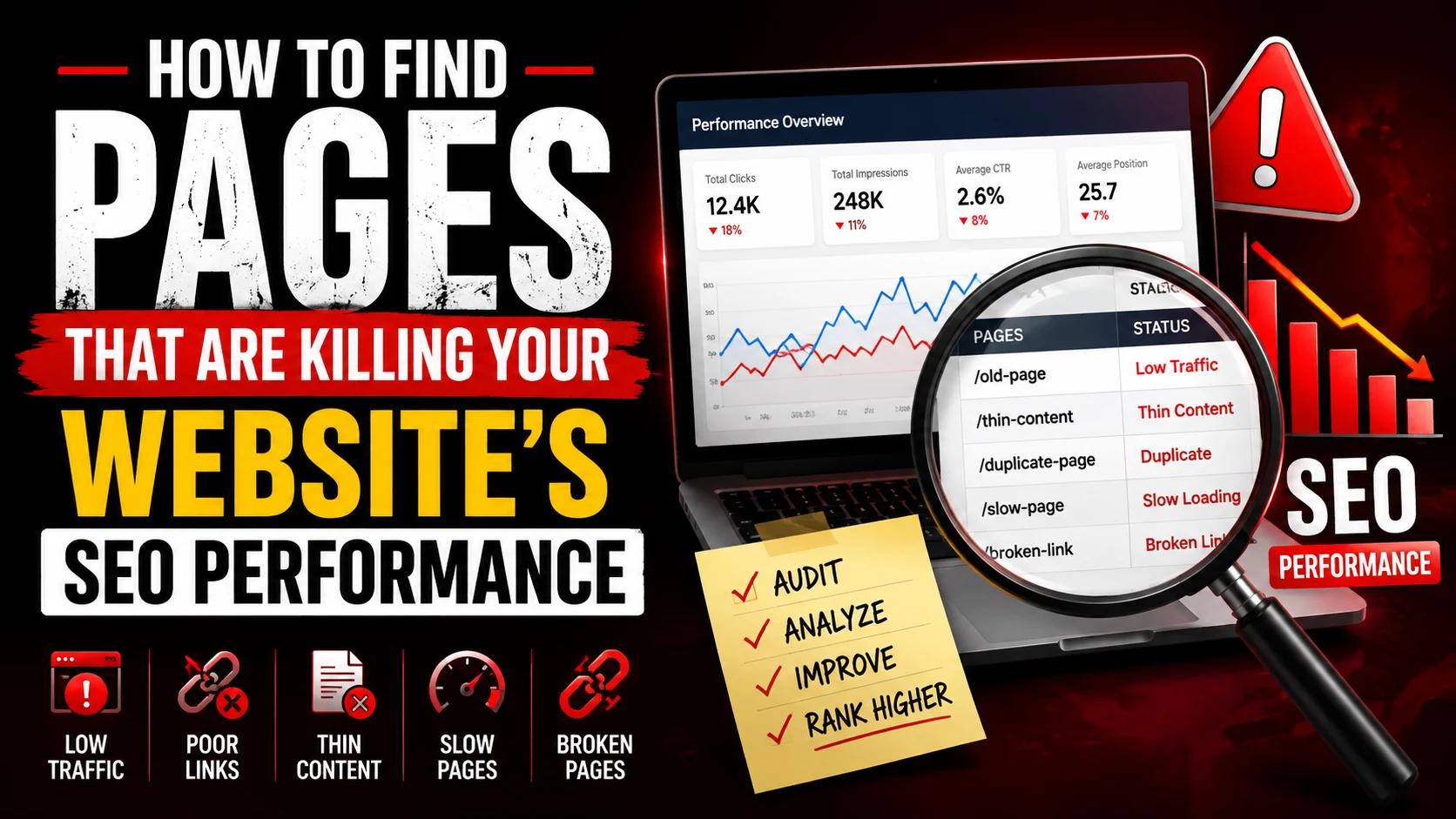
Luckily enough, there is a way through which you can identify such pages through an SEO audit. That is because SEO audit techniques like Google Search Console, website analytics, sitemap, content audit and internal link audit can enable you to do so.
What Does Poor SEO Performance Mean?
Low SEO performance does not mean that the page will not have any traffic. The page may be underperforming but still be informative, help other pages, or fulfil some search needs.
However, the issue becomes worse when the page does not bring value, when it competes with other URLs, when there are some technical issues, or when it does not satisfy the search needs.
This is because there may be different pages on one site providing services of the best SEO agency in Delhi. When these pages are about the same thing, it will be hard for search engines to decide which page should be indexed.
Therefore, the SEO audit must include the value of content, the search intents, the indexing issues, the technical side of the website, and its architecture.
Start With Google Search Console
Google Search Console is one of the most useful tools for investigating declining SEO performance.
Open the performance report and review:
Clicks
Impressions
CTR
Average position
Search queries
Top-performing pages
Look for pages that previously generated impressions or clicks but have recently lost visibility. These URLs should be investigated rather than immediately deleted.
You can compare different periods to identify pages experiencing a noticeable decline.
Check the Indexing Report
The Pages or Indexing report can show whether Google has successfully indexed your important URLs.
Pay attention to pages marked as:
Not indexed
Crawled but not indexed
Discovered but not indexed
Duplicate pages
Pages with canonical issues
Not every excluded URL is necessarily a problem. Your priority should be URLs that are valuable, unique, and intended to appear in search results.
Find Thin and Low-Value Pages
Thin content is another common problem that can affect website quality.
A page may need attention if it contains very little useful information, repeats content from another URL, or doesn't provide a meaningful answer to the user's query.
Look for:
Very short service pages
Outdated blog posts
Empty category pages
Duplicate location pages
Similar service pages
Pages with little original information
For example, a digital marketing website targeting the best SEO service provider in Delhi should make sure its service page provides useful information about services, processes, experience, industries, reporting, and other relevant details instead of simply repeating the same promotional text.
Don't automatically delete every short page. If the topic is valuable, improve the content and make it more useful.
Check Keyword Cannibalisation
Keyword cannibalisation happens when multiple pages target the same or very similar search intent.
Imagine a website has separate pages targeting:
best SEO company in Delhi
SEO company in Delhi
SEO agency in Delhi
best SEO agency in Delhi
All these keywords complement each other. However, there is nothing necessarily wrong in having two different webpages for the above mentioned keywords; however, if both webpages contain almost similar content targeting the same audience group, there would be an obvious clash between them.
Check out how much both webpages have in common in relation to the content, title, keyword, backlink, internal linking and heading.
If both the URLs fulfil the same purpose, it would be best to combine both into one single good-quality webpage.
Analyse Your Internal Linking
Internal linking will help both people and the search engines to locate the crucial pages.
No matter how much quality content any page may have, it cannot make any achievement without having enough links coming to it from other pages.
For example, if you are running a business website catering to SEO services in Delhi, then the crucial service pages must be linked from your blogs and other related pages.
You can also use contextual anchor text such as:
SEO agency in Delhi
SEO services in Delhi
SEO service provider
professional SEO services
Avoid adding the same keyword to every internal link. Anchor text should describe the destination naturally.
Look for Duplicate and Canonical Problems
Duplicate or highly similar URLs can create unnecessary SEO complications.
Check whether your important pages have:
A correct canonical URL
Consistent HTTPS versions
Proper redirects
Consistent internal links
The preferred URL included in the sitemap
For example, if your keyword is about SEO agency Delhi, then it becomes important for you to make sure that there are no duplications of the same URL fighting against each other based on the below-given points.
A clean URL structure makes it easier for search engines to understand your website.
Review Technical SEO Problems
Technical problems can also affect SEO performance.
Check important URLs for:
404 errors
Server errors
Redirect chains
Broken internal links
Accidental noindex tags
Incorrect robots.txt rules
Mobile usability issues
Slow-loading pages
In case you are claiming that you are among the top SEO service provider firms in Delhi, then technical superiority should be an essential part of your website. The websites that offer SEO services must have high technical standards on their own pages.
Check Your Sitemap
Your sitemap must have the vital canonical URLs you want search engines to discover.
If you have recently added some pages to your SEO services in Delhi or an SEO agency in Delhi, it will be necessary to see whether those URLs are included in your sitemap.
A dated sitemap can complicate things for search engines while searching for new URLs.
For websites coded individually, it will be better to get an automatically generated sitemap than edit your XML file manually each time a new page gets added.
What Should You Do With Weak Pages?
Once you find problem pages, do not immediately delete them.
Use the following approach:
Improve – keep the URL if the content itself is valuable but needs to be improved.
Combine – combine pages if their function is the same for the same search intent.
Redirect – redirect the page if there is another updated one replacing it.
Delete – delete those pages which do not add any value to the site at all.
Keep – not all low-traffic pages are useless for the visitor; there are those which have their function.
It is not about maximising the number of pages. It is about creating a website with all important pages having their own functions.
Final Thoughts
In order to identify those web pages which can hamper your SEO performance, it is very important for you not only to analyze those URLs which have the least number of visitors. It is crucial to take into account the visibility of web pages in search engines, quality of the content, keywords targeted, internal linking, indexing, technical problems, and user intent.
If you want your website to compete for the top positions in competitive keywords like "best SEO agency in Delhi", "best SEO company in Delhi", "SEO company in Delhi", "best SEO services in Delhi" or "best SEO agency Delhi", then it is important for you to give some unique information to your users.
Through regular audits, you will be able to identify those pages that are underperforming and can create problems for you in future. You can update the content of your site, remove duplications, establish internal links, fix technical issues, and update the sitemap.


Comments (0)
No comments yet. Be the first to comment!