
 New Delhi


Why Some Pages Rank Without Backlinks While Others Don’t
While some pages rank without backlinks due to their ability to match the searcher’s intent, have good topical relevance, and be backed by a quality website, other pages do not rank because they are inferior to other pages in some way.
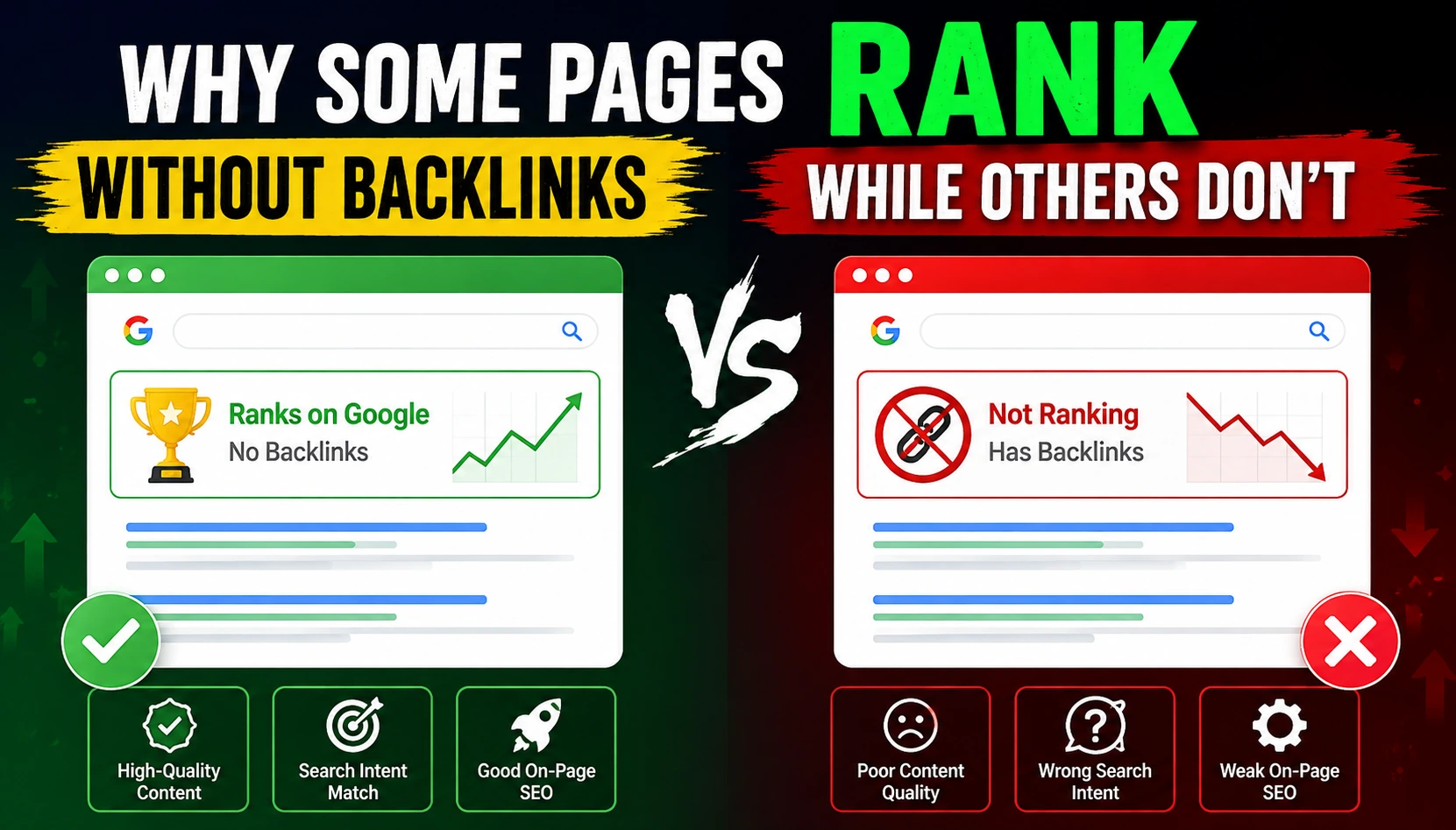
Backlinks Are Not the Only Ranking Factor
Backlinks have always been an essential part of SEO. Links from trusted sites provide a search engine with information about how relevant and/or important the content of the page could be.
But ranking is not merely about competing for having more backlinks than others.
A page with a low number of links from other websites may rank above another page with many links if its content answers the question posed by the user better. This happens especially in cases of narrow searches with little competition.
This is why companies need to focus on other aspects besides backlinks while assessing their SEO results.
Search Intent Can Make the Difference
Search intent is the purpose for which the search query has been input in the search engine by the user.
When someone types in the query “how to fix slow website speed,” he/she aims to find solutions to his/her problem. Someone else who searches for “SEO agency pricing” may just be doing some analysis. Finally, the one who searches for “what is technical SEO” simply wants to find an answer.
As the probability of providing such information on your web page increases, the performance of your page increases accordingly.
Even when the relevance of the particular web page is very high, it can still rank without backlinks because of the high relevance compared to other linked pages.
Topical Authority Strengthens Your Website
Search engines need context to understand what a website is about.
A website that consistently publishes useful information around a particular subject can build topical authority over time.
For example, a digital marketing website might publish resources covering:
Technical SEO
Keyword research
Local SEO
Content marketing
Google Business Profile optimization
Link building
SEO analytics
Search engine updates
When these pages are connected logically, they create a stronger topical structure.
This can help new content perform because the website already demonstrates knowledge and relevance within the subject area. In some cases, this makes it possible to rank without backlinks to every individual page.
Internal Links Create Valuable Connections
Often, internal linking tends to be neglected by businesses when they pay much attention to external backlinks.
For example, if you write an article on technical SEO, you may put internal links to pages dedicated to crawling, indexing, Core Web Vitals, redirection, XML sitemaps, and website architecture, among others.
The search engines will be able to establish connections between various subjects on your site.
Moreover, your site visitors will be able to find more information.
With an efficient internal linking system, significant pages will have more context, and some articles will be able to rank without backlinks despite the lack of links.
Quality Matters More Than Word Count
A longer article is not automatically a better article.
Searchers want useful information, not unnecessary paragraphs written simply to increase word count.
Competitive content should answer the main question clearly and provide information that helps the reader make a decision or solve a problem.
Useful additions may include:
Original examples
Practical recommendations
First-hand experience
Data and evidence
Expert insights
Case studies
Updated information
Answers to related questions
The objective should be to create the most useful resource for the intended query rather than producing the longest article on the topic.
E-E-A-T Can Strengthen Content Credibility
Experience, expertise, authoritativeness, and trustworthiness are key concepts in creating credible online content.
Companies should be able to show their expertise rather than just asserting that they are experts.
A firm trying to target the keyword "Best SEO Agency in Delhi," for instance, would enhance its credibility by providing useful information on SEO, having relevant case studies, explaining its process, offering information about its services, and possessing practical expertise.
This results in an improved user experience, as well as better context of the firm’s expertise.
How Pages Rank Without Backlinks Through Strong SEO
Not necessarily should a page have lots of backlinks if the general SEO approach on that page is strong.
Consider two pages that compete against each other.
The first one has 100 backlinks and just gives a standard answer on the search query.
The second one has five backlinks and actually answers the search query, covers all sub-topics that relate to that search query, provides good internal linking, and comes up with some new ideas regarding that search topic.
The second page will have more opportunities to get indexed and rank without any links because the relevance and the value matter more than the number of links in this case.
This is especially true for the long-tail search queries.
Fresh Content Can Maintain Search Relevance
Not every search requires fresh information, but some topics change rapidly.
SEO, artificial intelligence, Google updates, advertising platforms, software features, and digital marketing trends can become outdated quickly.
If an article contains old statistics, outdated recommendations, or obsolete information, another resource with current information may become more useful.
Updating content should therefore involve more than changing the publication date.
Review the facts, examples, recommendations, statistics, terminology, and user questions. Add meaningful information wherever necessary.
AEO and GEO Are Expanding Search Visibility
Present-day SEO, on the other hand, is not limited merely to traditional search.
AEO involves clarifying information and making it easier for answer-based searches to comprehend it. GEO involves clarifying information and making it searchable, understandable, and citable using AI-based searches.
Both approaches involve content structuring.
Use your headings explicitly, be direct in answering your readers’ questions, explain your ideas, use entities, cite examples, and support your statements.
For example, having a heading “Is it possible for a page to rank without backlinks?” at the top of your content will help answer your readers’ questions and also clarify the intention of your content to search engines.
Why Some Good Pages Still Fail to Rank
If your content is genuinely useful but still does not perform, backlinks may not be the main problem.
Check the complete SEO picture:
Is the keyword highly competitive?
Does the page match search intent?
Are multiple pages targeting the same keyword?
Does the page have enough internal links?
Is the website technically healthy?
Does the content provide unique value?
Do competitors demonstrate stronger experience?
Is the page mobile-friendly?
Does the website have sufficient topical coverage?
These questions can uncover ranking problems that a backlink report alone cannot identify.
Build Content That Deserves Visibility
The goal should not be to avoid backlinks completely.
Instead of that, try to make the pages competitive through relevance, usefulness, technicality, and credibility. The first step should be analyzing the intent and conducting keyword research, followed by complete coverage of the topic.
Connect the related resources. Make topic clusters. Enhance page experience. Create fresh insights and evidence. Update and organize the content properly for search engines and AI search engines.
Only after achieving these fundamentals should backlinks be treated as an additional step instead of the only reason for making the pages competitive.
Final Thoughts
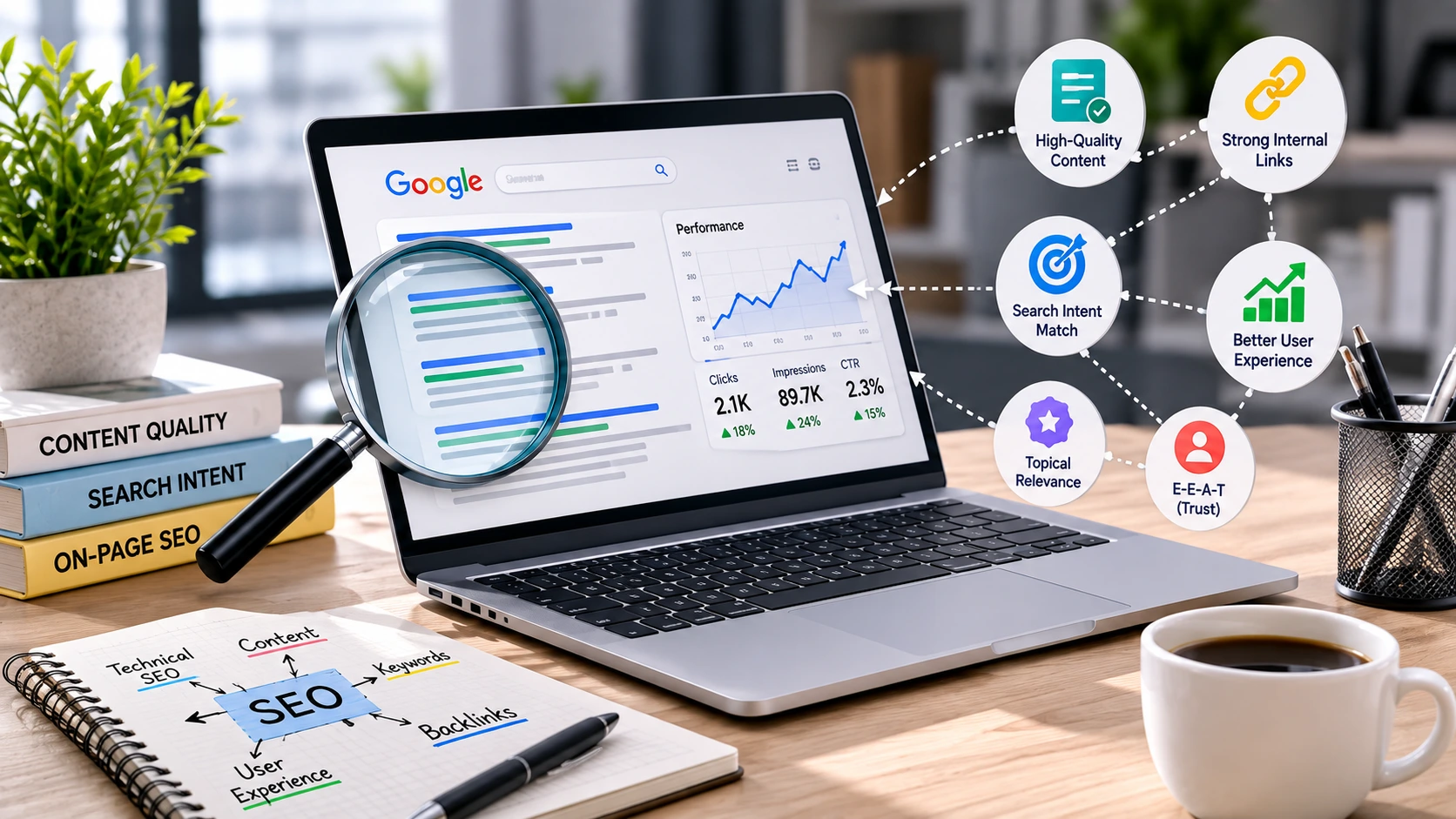
The reason why certain pages rank without backlinks while others don’t is the fact that SEO involves many more factors apart from backlinking. Factors such as search intent, topical relevancy, internal linking, content quality, technical SEO, recency, user experience, and authority all play a role in ranking.
While backlinks are certainly a must, especially for competitive keywords, companies that pay exclusive attention to building them may forget about their primary purpose—to produce content that deserves to rank.
What matters is for the page to be useful to the users, understandable for the search engines, and built in such a way as to be perceived by AEO/GEO.


Comments (0)
No comments yet. Be the first to comment!