 New Delhi


LinkedIn Lead Generation Strategy for B2B Service Providers
The platform can present opportunities to service providers in the B2B sector, like digital marketing companies, IT companies, consultancy firms, SaaS companies, web development companies, etc.
What Is LinkedIn Lead Generation?
Lead generation on LinkedIn involves identifying prospective business clients through LinkedIn and turning these interactions into real sales leads.
Unlike any other form of advertising, LinkedIn allows users to obtain specific professional information that can help businesses target prospects based on:
Job title
Industry
Company size
Location
Seniority
Skills
Business interests
The objective isn't to collect thousands of random connections. The real objective is to build relationships with people who are likely to need your services.
Start With the Right Target Audience
Before contacting anyone, define your Ideal Customer Profile (ICP).
Ask yourself:
Which businesses need your service?
What industries should you target?
What company size is ideal?
Who makes the purchasing decision?
What problems are they facing?
Which locations do you serve?
For instance, there is an internet marketing company that focuses on the B2B segment and can target either the founders/CEOs, marketing directors or the business development directors of small and medium-sized businesses.
Having defined your target audience, everything else in your LinkedIn marketing strategy will work out well since you would be able to tailor the message according to that audience.
Optimize Your LinkedIn Profile for Conversions
Your LinkedIn profile is often the first place a prospect visits after seeing your content or receiving your connection request.
Instead of using a generic headline such as:
Digital Marketing Expert | SEO Consultant
Use a customer-focused headline:
Helping B2B SaaS Companies Generate Qualified Leads Through LinkedIn & Digital Marketing
Whom do you help? What sort of outcome can you bring to your clients? This is all necessary information that should be included in your profile.
Moreover, the following items must be included in your profile: About You, Experience, Client Outcome, Case Study, Testimonials, and Resources in the Featured section.
Think of your profile as a mini landing page. Within a few seconds, visitors must know what you do, whom you help, and why they should go further into your profile.
Create Content That Solves Business Problems
Content marketing is the best way to build credibility on LinkedIn.
However, posting promotional content daily may lead your page to be seen as an advertisement.
Rather than that, you should post about problems that your prospects are having.
For example, instead of:
“We provide professional LinkedIn lead generation services.”
create:
“5 Reasons Your LinkedIn Outreach Isn't Generating B2B Leads.”
Other useful topics include:
B2B marketing mistakes
Industry trends
Client success stories
How-to guides
Case studies
Marketing statistics
Practical checklists
Frequently asked questions
Lessons learned from projects
This type of content demonstrates expertise while giving your audience a reason to follow and engage with you.
Use Search-Friendly Topics Naturally
Your LinkedIn content can also support your wider online visibility when you create content around topics people genuinely search for.
For example:
How to generate B2B leads on LinkedIn
How to find decision-makers on LinkedIn
LinkedIn marketing strategy for B2B companies
How to improve LinkedIn lead generation
Best LinkedIn strategies for B2B service providers
Avoid keyword repetition where unnecessary. Use them where necessary, providing relevant responses.
Content that is question-driven is valuable because people tend to ask full-fledged questions while searching online. A good response followed by good examples can help make sense of your content.

Build Authority With First-Hand Experience
Sharing experiences will work better for adding credibility to B2B content as opposed to sharing marketing tips.
For example, it would be insightful to write about the experience of a certified client whereby the use of the benefits-oriented LinkedIn headline, as opposed to the default one used to indicate the job title, helped in visibility and lead generation.
A suitable example could be:
Client Example: certoceanTech changed its LinkedIn headline to “Helping B2B SaaS Companies Generate Qualified Pipeline Through LinkedIn.” After the profile optimization, profile views increased by 40%, while the company generated five inbound leads within two weeks.
Such kind of data is useful since it demonstrates how one optimization is linked to a certain outcome.
Publish only the numbers that have been obtained from real, documented outcomes. In case you are giving an example for illustration purposes, make sure that you do not present the example as a result obtained from your client.
Find the Right Prospects With LinkedIn Search
Once your audience is defined, start identifying relevant prospects.
For example, a B2B marketing agency might search for:
Marketing Director + SaaS + Delhi NCR + 11–200 employees
Both LinkedIn and Sales Navigator provide many useful professional searching tools that will help you to filter your prospects according to such criteria as job title, company size, geographic location, industry, seniority level, and others.
The idea is not to send hundreds of letters each day.
The goal is to develop a more precise list of prospects and adjust your communication based on their position, company, activity, etc.
Use Personalized Outreach
A connection request should feel like the beginning of a professional relationship, not an advertisement.
A simple outreach message can be:
Hi [First Name],
I came across your profile while researching B2B companies in [Industry]. I noticed you're working on [specific area]. I regularly share insights around [relevant topic], so I thought it would be useful to connect.
— [Your Name]
After the prospect accepts:
Thanks for connecting, [First Name]. I noticed [specific observation about their business]. We've recently seen a similar challenge around [problem]. Happy to share a few practical ideas if it's relevant to your current goals.
The most important rule is simple: personalize before you pitch.
Don't immediately send your pricing, service brochure, or a long company introduction. First, understand whether there is a genuine business need.
Our 3-Step LinkedIn Funnel Formula
A simple way to structure your LinkedIn strategy is:
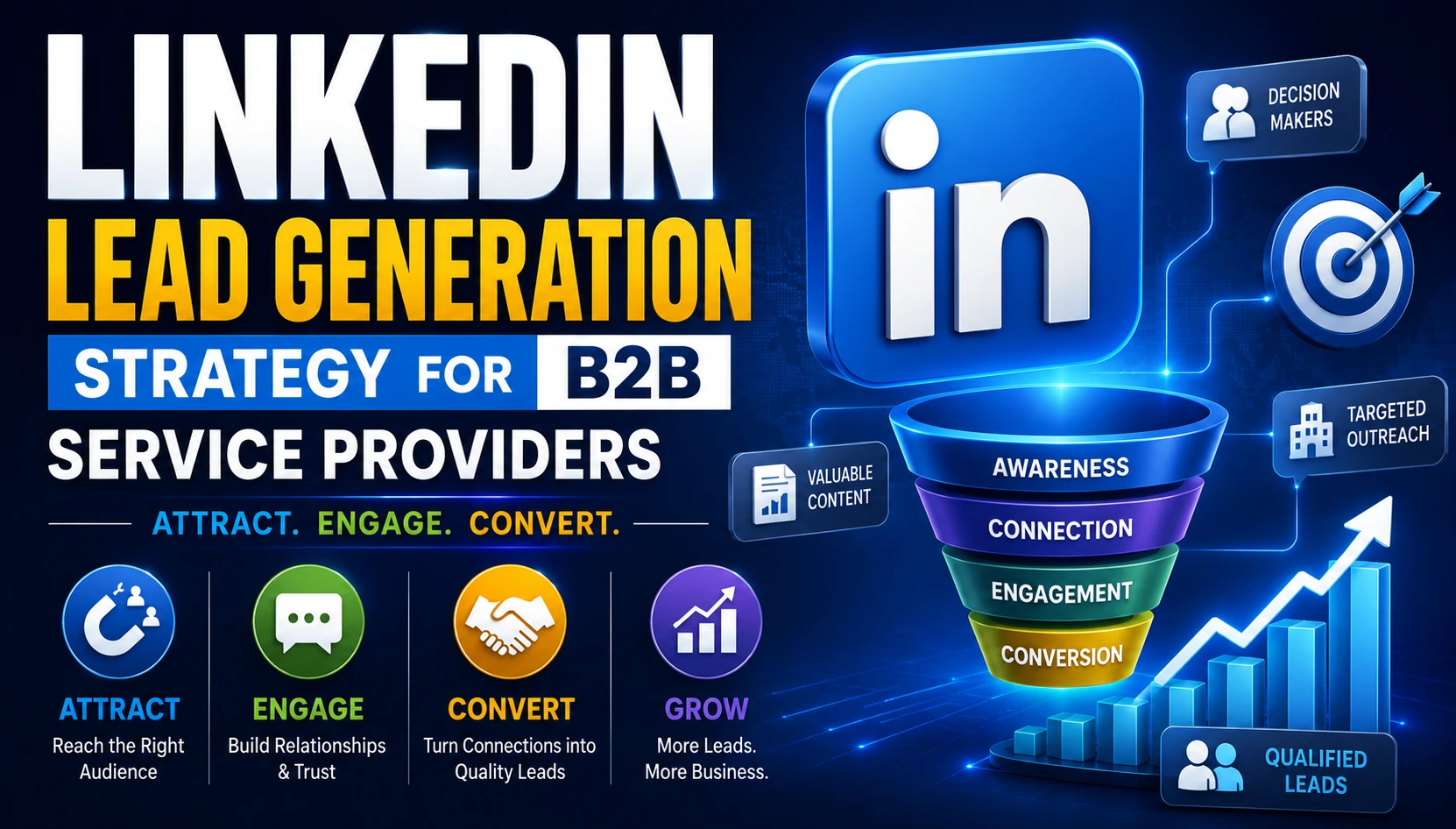
Attract → Engage → Convert
Attract
Publish useful content that attracts your ideal customers.
Engage
Interact with relevant prospects through comments, conversations, useful resources, and personalized communication.
Convert
When a prospect shows genuine interest, guide them toward the appropriate next step, such as a consultation, audit, strategy call, demo, or proposal.
The complete journey looks like this:
Useful Content → Profile Visit → Connection → Conversation → Qualified Lead → Sales Opportunity
This approach is more sustainable than constantly sending cold sales pitches.
Use the Featured Section Strategically
Your LinkedIn Featured section can act as a small resource hub for potential clients.
Add your strongest assets, such as:
Case studies
Portfolio
Website
Lead magnets
Industry reports
Client success stories
Guides
Free consultation pages
For example, if someone visits your profile after reading your LinkedIn post, the Featured section can immediately direct them toward your strongest proof and resources.
This creates a natural path from content discovery to business enquiry.
Measure the Right LinkedIn Metrics
Don't measure your entire strategy through likes and followers.
Track metrics that are connected to business growth:
Profile views
Connection acceptance rate
Content engagement
Website visits
Inbound enquiries
Qualified leads
Consultation bookings
Sales opportunities
Lead-to-client conversion rate
A post with 2,000 views and three qualified leads can be far more valuable than a post with 20,000 views and no business enquiries.
For B2B service providers, lead quality matters more than vanity metrics.
Frequently Asked Questions
Is LinkedIn efficient in B2B lead generation?
Yes. LinkedIn does an excellent job when used by B2B companies because it allows you to locate people on the basis of their profession, industry, company information, hierarchy, and geographical location.
How often should a B2B company post on LinkedIn?
Maintain a steady frequency of posting along with quality content. A couple of times a week is enough to make you visible without flooding your followers with content.
Is it a good idea to add a sales pitch in connection requests?
Not really. Just send them a connection request that suits the individual, and once you have understood his/her requirements, you can go ahead and sell your service.
What kind of content on LinkedIn helps in generating B2B leads?
Educational content, customer success stories, problem-solving, and other types of similar content may help in this regard.
Final Thoughts
A good LinkedIn lead generation approach for a b2b service company does not revolve around accumulating as many contacts as possible. Rather, it involves connecting with the right decision makers, establishing one’s expertise, gaining trust, and converting valuable dialogue into business leads.
One should determine his/her target customer, optimize their profile, create valuable content, find the appropriate prospects, customize the approach and track the outcomes that make a difference to sales.
If LinkedIn is viewed as a relationship medium, not as a tool for continuous self-promotion, it can be a strong source of B2B lead generation.


Comments (0)
No comments yet. Be the first to comment!