 New Delhi


Digital Marketing in India 2026: Market Size, Statistics, Trends and Growth
If you run a business in India, you've probably felt it already — the conversation has shifted. Nobody's asking, "Should we do digital marketing?" anymore. They're asking, "Why isn't it working yet?" That's because the market underneath your feet has changed shape completely in the past two years. Let's walk through what the numbers actually say and what they mean if you're trying to grow a business here in 2026.
Digital Marketing in India: Current Market Overview
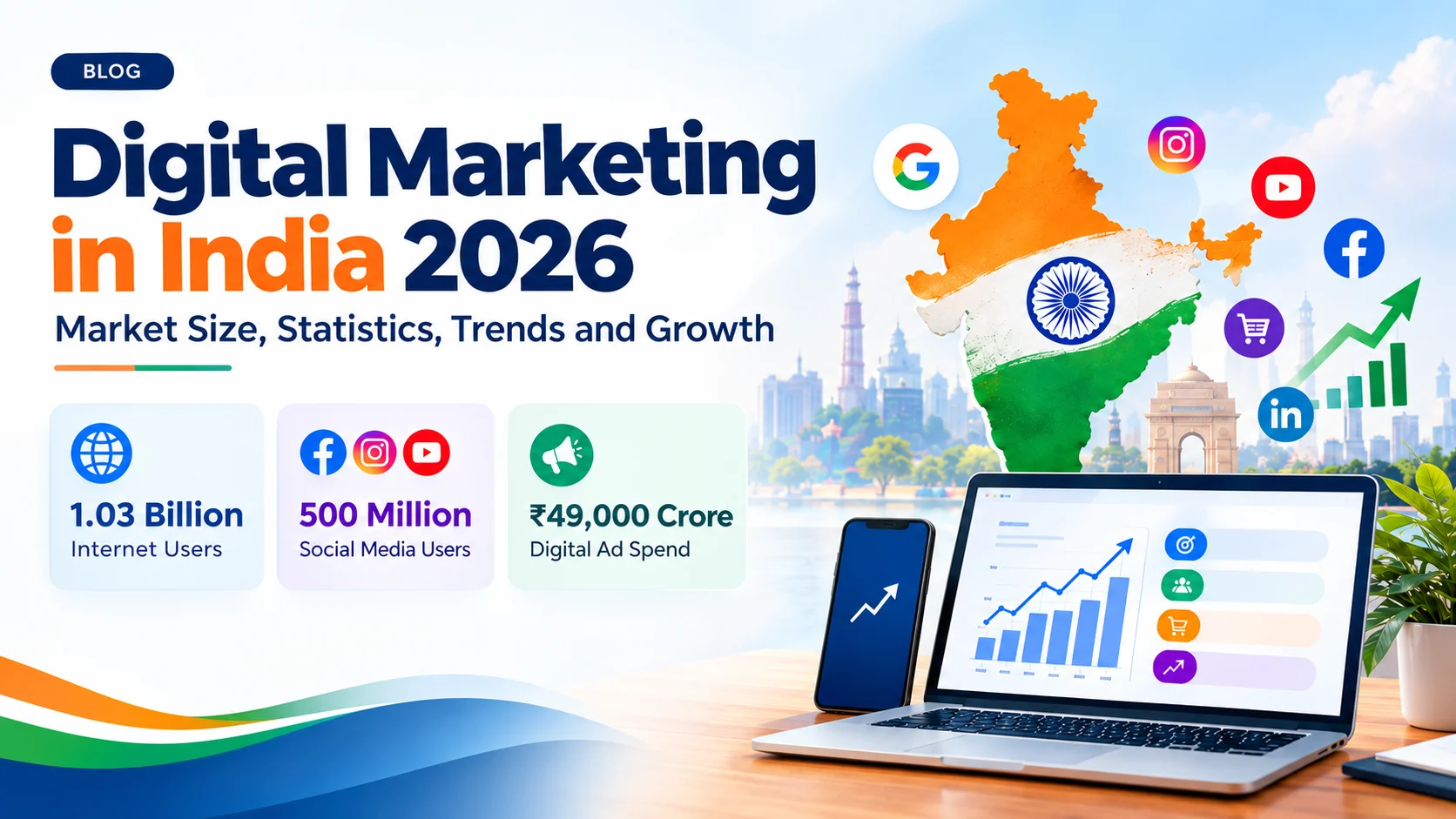
Here's the headline number: India's total advertising market crossed ₹2.01 lakh crore in 2026, growing 9.7% year over year. But the more telling number is what's happening inside that pie. Digital now accounts for 68.1% of all ad spend in the country, which puts India firmly in the "digital-majority" club alongside the world's most mature ad markets.
Depending on which industry report you read, the exact split shifts a little — the Pitch Madison Advertising Report puts digital's share at around 60-64% under its expanded definition, while WPP Media's figure runs closer to 68%. The gap comes down to how each firm counts things like quick-commerce ads and MSME spending. Either way, the direction is the same: digital contributed the vast majority of net growth in the ad market in 2025, while traditional media actually declined slightly. Television isn't dying, but it's no longer where the growth is.
Digital Advertising Market Size in India
Break down the digital pie a bit more, and a few things stand out:
Ecommerce and retail media advertising alone accounted for a total of ₹10,257 crore in 2025, reflecting a growth rate of 27% year on year, making it one of the fastest-growing segments of the overall market.
Quick commerce advertising (for instance, Blinkit, Zepto, and Swiggy Instamart) reported an increase from ₹1,325 crore in 2024 to ₹4,000 crore in 2025, a whopping growth of 202%, further expected to increase to around ₹6,000 crore by 2026.
Digital advertising expenditure from MSMEs (specifically from small and medium enterprises) stood at ₹35,814 crore in 2025 and is expected to further grow at a rate of approximately 20%, reaching around ₹42,976 crore in 2026.
That last stat matters most if you're a smaller business: you're not a niche player anymore. MSME budgets already make up roughly 38% of core digital ad spend, collectively rivalling television and print as standalone categories.
Internet and Mobile User Statistics in India
India ended 2025 with 1.03 billion internet users, putting online penetration at 70% of the population. Cellular mobile connections stood at 1.06 billion, equal to 72.5% of the population. That's an enormous, still-growing audience — and most of it is mobile-first, not desktop-first.
Data consumption tells the same story from a different angle. Average smartphone data usage in India has climbed sharply over the past few years, and India continues to rank among the highest in the world for average traffic per user, driven by cheap data plans and a genuinely mobile-native population.
Social Media Marketing Statistics in India
As of October 2025, India has logged 500 million social media identities. This means that 34.1% of the population uses social media. This percentage may be lower than internet penetration. However, the growth rate is striking. The number of social media users has grown by 5.23% in India, while the global average increase is only 0.81%. India is one of a few places in the world where social media is still experiencing significant growth.
WhatsApp leads platform usage, reaching 80.8% of internet users monthly, followed by Instagram at 77.9% and Facebook at 67.8%.
YouTube, Instagram and Facebook Marketing in India
Platform-by-platform, the reach numbers are staggering for a single country:
Instagram reported 481 million users in India in late 2025, based on Meta's own advertising tools.
Facebook had over 704 million users in India as of August 2026, accounting for 47.3% of the population, with men making up roughly 69.5% of that base.
LinkedIn crossed 200 million users in India, about 13.5% of the population, and it's increasingly a serious B2B channel here, not just a resume repository.
YouTube remains the single largest platform by reach in the country, comfortably sitting above 500 million users.
If your brand isn't showing up natively — meaning short-form video, not just repurposed TV ads — you're leaving a huge chunk of that audience untouched.
SEO and Search Marketing in India
Search still runs on rails owned by one company: Google held 97.21% of the search engine market in India as of July 2026, with Bing a distant second at 1.18%. If your SEO strategy isn't built around how Google actually ranks and surfaces content today — including AI Overviews — you're utilising search engine optimisation for a tool that has not been developed. Statcounter
The most significant change is the implementation of the artificial intelligence stand. Google now employs search engines which use AI for understanding more than 98 languages of the world, including Hindi, Tamil, Telugu, Bengali, Marathi, Gujarati, Kannada and Malayalam. They now focus on credible sources made available in the language of the country and do not depend on the English version of the content. Hence, SEO in India involves more than just the ranking as of 2026 but also the citations of the content in the AI world.
Google Ads and Paid Advertising in India
Paid search and display are still growing at a healthy clip. One recent industry estimate put India's digital advertising sector on track to touch roughly $8.15 billion by the end of 2026, growing at just over 19% annually. Combine that with Google's near-total grip on search, and Google Ads remains the single highest-leverage paid channel for intent-based buying in the country — particularly for anything transactional (bookings, purchases, lead forms).
Performance Marketing and Lead Generation in India
This is where the MSME and startup story gets concrete. A recent Google-backed study covering over 3,200 small and medium businesses found that digital advertising by MSMEs generated ₹49,731 crore in economy-wide output during 2025, contributing ₹32,307 crore in gross value added and around ₹6,534 crore in GST collections. On the ground level, nearly 60% of businesses using digital advertising reported double-digit revenue growth, and 66% said it helped them reach entirely new markets.
That's not abstract "brand awareness" talk — that's measurable lead-to-revenue performance, at scale, across thousands of small businesses.
E-commerce and Digital Marketing Growth
Different research organisations produce varying predictions, yet all projections graphically appear consistent throughout. According to GlobalData, the e-commerce market in India should be about $225.9 billion in the year 2026, a growth of 12.4% from the previous year. The other players in the industry tend to estimate current GMV at different rates, helping to widely agree that even the most conservative projection will see the market reach the $300 billion mark.
A few operational numbers worth knowing if you sell online:
Mobile commerce already accounts for around 82% of all e-commerce transactions in India.
62% of new online shoppers are now coming from tier-2 and tier-3 cities — the metros are no longer where the growth is.
UPI dominates payments with roughly a 73% share, while cash on delivery has fallen to just 18%.
If your funnel still assumes desktop browsing and COD as the default, it's built for a market that stopped existing a few years ago.
Digital Marketing for Small and Medium Businesses
According to experts, MSMEs are very important. Surveys in 2025 show that 80% of Indian SMEs grew in 2025; this is much more than the average growth reported across Asia-Pacific (63%). Not only that, 89% of Indian SMEs have also confirmed their earnings will be more than 10% because of the digital economy.
Another important figure is that 74% of businesses mentioned they were able to gain a considerable amount of wealth from their online sales.
A small business owner can be sure he/she does not have to compete against giant digital firms with multi-billion-dollar budgets. Instead, he/she has to compete against other small businesses which do understand that good Google Ads work may bring profit much higher than that of a larger and less efficient competitor. that
Why Mobile Marketing Matters in India
This topic has almost reached the point of redundancy, as mobile is now evidently the standard. With more than one billion active users of the internet and over 1.06 billion mobile connections, with mobile leading the majority of e-commerce activities, campaigns not designed with mobile in mind are made for a minority that is rapidly declining. This entails the use of vertical video, quick-loading landing pages, WhatsApp as a marketing medium and ads that operate with the sound off and take three seconds or less to load on the six-inch screen.
Regional Language and Local Digital Marketing
This is probably the most underrated opportunity in Indian digital marketing right now. An estimated 900 million Indians don't search in English — and until recently, most brands treated regional-language content as an afterthought, translating English blogs and hoping for the best. That's changing fast, partly because Google's AI search tools now understand regional intent natively rather than through translation layers.
If you're only publishing in English, you're optimising for a shrinking share of the internet-using population, not the majority of it.
AI and the Future of Digital Marketing in India
AI adoption in marketing has moved from "interesting experiment" to "table stakes" faster than almost anyone predicted. Globally, 87% of marketers now use generative AI in at least one workflow, up from just 51% in 2024, and Asia Pacific adoption sits at around 84%. In India specifically, Google's own research suggests AI could unlock a 30-35% improvement in profitability for MSMEs that adopt it well, though skill gaps and limited budgets remain real barriers for smaller businesses trying to keep up.
Practically, this shows up in three places for most Indian marketers today: AI-assisted content creation (still the biggest use case by far), smarter ad bidding and targeting, and — increasingly — visibility inside AI chat answers themselves, not just traditional search results.
Digital Marketing Trends to Watch in 2026
Pulling the threads together, a few trends stand out heading into the rest of the year:
Quick-commerce advertising is the fastest-growing ad category in the country, expanding well over 100% year-over-year in some segments.
Retail media — ads placed directly on e-commerce and quick-commerce platforms — is becoming a serious budget line, not an afterthought.
Regional-language and vernacular content is shifting from "nice to have" to genuinely competitive, especially as AI search tools get better at understanding Indic languages natively.
Tier-2 and tier-3 cities are driving the next wave of both internet growth and e-commerce growth, not the metros.
AI-native search behaviour (AI overviews, conversational search) means SEO strategy needs to account for being cited by AI, not just ranking on a results page.
What These Numbers Mean for Indian Businesses
The reality is very simple: With over 1 billion internet users in India today, significant portions of ad expenditures have been shifted to the online space for good, and there are many proofs of why digital activities work and succeed. Among the companies in this space, not always the ones with the largest budgets are emerging victorious, but rather the ones that managed to move their operations to mobile and optimise their activities to meet the current search patterns of consumers (unlike those five years ago).
What is hard to accept about all these figures is that some amount of digital marketing that one manages to do to gain an edge over competitors is absolutely not enough, since it is highly probable that competitors are also actively engaged in the endeavour.

Comments (0)
No comments yet. Be the first to comment!